Best mutual funds and index funds to invest in India (2026)
The 2026 shortlist across every category that matters for an Indian investor: large cap, flexi cap, mid cap, small cap, ELSS, index, debt, liquid. With the score, the rationale, and the live rankings link for each.
In this guide
- 1Decide your goal and horizon before picking a fund. The first question is not 'which fund'. The first question is 'what am I saving for, and when do I need it'. The fund category follows from the answer, not the other way around.
- 2Pick the category, not the #1 fund. A single category of mutual funds is not a portfolio. The point of a 'best mutual funds' list is to shortlist within a category, not to pick the one fund that will solve your retirement. A 28-year-old building a 20-year retirement SIP needs exposure to at least large cap, flexi cap, and (eventually) mid or small cap, not just one fund.
- 3Use the score, not the headline return. The 1Y return column is a popularity contest. The 3Y and 5Y columns are the actual track record. A fund with a great 1Y and a mediocre 3Y is a momentum call; a fund with a consistent 3Y and 5Y in the top quartile is a real pick.
- 4Check overlap before you start an SIP. Two top-ranked funds can hold the same 40 stocks. A Flexi Cap and a Multi Cap from the same house with the same fund manager often behave like one fund. The FinvestR agent reads your CAS and flags this kind of overlap in plain English.
- 5Step up the SIP every January. The 10% annual step-up is the single most powerful lever in your control. A ₹5,000 monthly SIP that runs for 20 years at 12% pre-tax compounds to roughly ₹60L. The same SIP stepped up 10% per year for 20 years compounds to roughly ₹1.2 crore. That single habit, more than any fund choice, decides the size of your retirement corpus.
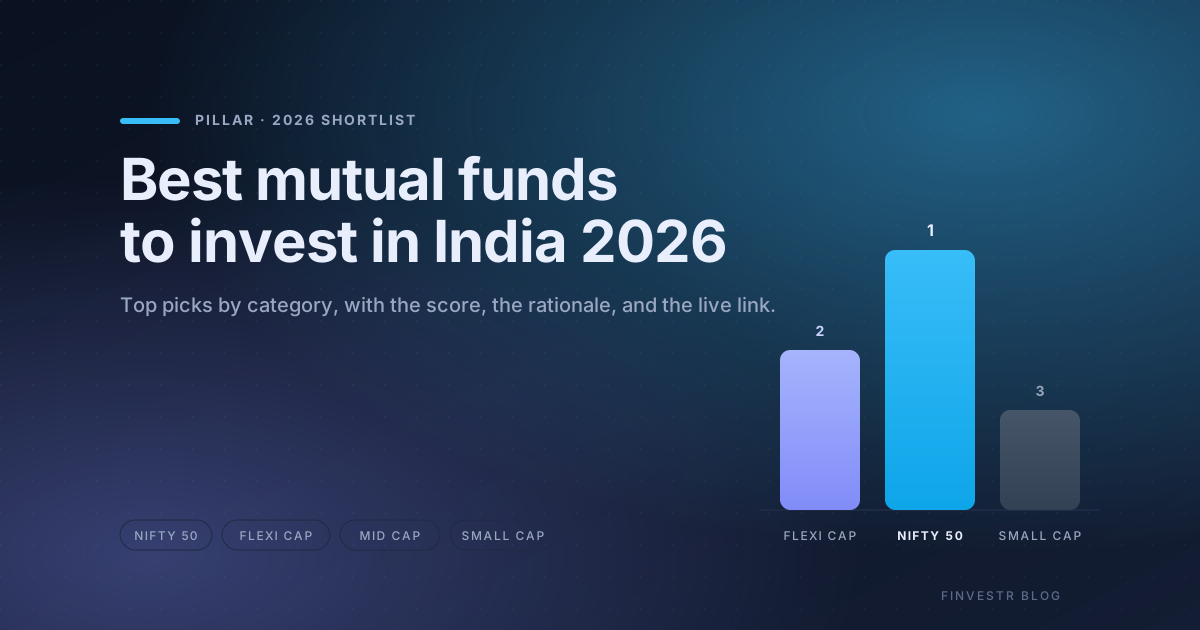
There is no single best mutual fund to invest in India. There is a best fund for each goal, each horizon, and each tax slab, and the right pick for a 30-year-old building a 25-year retirement SIP is structurally different from the right pick for a 55-year-old parking 5 years of pre-retirement savings in debt.
This post is the 2026 shortlist across every category that matters for an Indian investor. For each category, we name the top 1-3 funds based on the FinvestR score, with the rationale and the live rankings link for the full top-10. The goal is not to hand you a single answer. The goal is to give you a shortlist you can actually act on, with the reasoning that survives a 5-year review.
This pillar post is updated quarterly. The live /rankings page is updated monthly, and is the source of truth for any specific fund.
How to use this list
A few ground rules before the shortlist.
The shortlist is a starting point, not a finishing point. A 1-month ranking is a snapshot. A 5-year track record is a track record. The fund that is #1 in July 2026 may be #3 by October. Use the list to research, not to lock in a decision. The live /rankings page has the current top-10 with month-on-month movement and category filters, refreshed every month once the AMFI NAV file is reconciled.
The category matters more than the #1 fund in it. A single category is not a portfolio. The right answer for a 28-year-old is a 50/30/20 split across a Nifty 50 index fund, a flexi-cap fund, and a mid or small-cap fund, not 100% in whichever fund tops the all-categories table. Pick the category that matches the goal, then the fund within the category.
Check overlap before you start an SIP. Two top-ranked funds can hold the same 40 stocks. A Flexi Cap and a Multi Cap from the same house with the same fund manager often behave like one fund. The FinvestR agent reads your CAS and flags this kind of overlap in plain English. A practical walkthrough is in how to find duplicate mutual funds in your portfolio.
Step up the SIP every January. A 10% annual step-up is the single most powerful lever in your control. A ₹5,000 monthly SIP stepped up 10% per year for 20 years at 12% compounds to roughly ₹1.2 crore. The same SIP without the step-up is ₹60L. The step-up is the entire difference.
With that framing, here is the 2026 shortlist.
Equity: the core, growth, and satellite
Large Cap
The 50-60% of an equity portfolio for most retail investors. The category that owns the Reliance, HDFC Bank, Infosys, TCS, ITC-to-State-Bank cluster that drives the Nifty 50's weight. The job is steady, not exciting.
Top picks 2026:
- HDFC Large Cap Fund (Direct and Regular) - low-cost passive exposure to the Nifty 50 with a 5Y track record in the top quartile, expense ratio around 0.30%.
- Nippon India Large Cap Fund - the active counterpart, with a 5Y return meaningfully above the index in the rolling windows.
- Invesco India Largecap Fund - the highest 3Y return in the category in 2026, with a Sharpe ratio that justifies the pick.
For most retail investors, the HDFC Large Cap Fund is the cleanest answer. If you want active management, the Nippon or Invesco funds are the alternatives. See the full Large Cap rankings for the top 10.
Flexi Cap
The default for most investors. A flexi-cap fund can move freely between large, mid, and small caps, which means the manager can rotate to mid-caps when large-cap valuations are stretched (2021) or back to large-caps when mid-caps have run too hard (2024). That optionality is the product.
Top picks 2026:
- Parag Parikh Flexi Cap Fund - the highest 3Y and 5Y in the category, manager consistency, low portfolio turnover, the gold standard for flexi-cap.
- HDFC Flexi Cap Fund - the closest large-cap-house alternative, with a 5Y track record that has consistently beaten the index.
- quant Flexi Cap Fund - the highest 1Y return in the category in 2026, with a Sharpe ratio that makes the high-octane portfolio acceptable for aggressive investors.
If you can only own one equity fund, the Parag Parikh Flexi Cap is the answer for most readers. See the full Flexi Cap rankings for the top 10.
Mid Cap
The growth sleeve. The 20-30% of an equity portfolio for investors under 40. The category that has compounded the fastest over 10-15 year windows in Indian markets, with the volatility to match (40-45% drawdowns in 2008 and 2020).
Top picks 2026:
- Motilal Oswal Midcap Fund - the highest 3Y and 5Y in the category, with a quality-growth tilt that has outperformed in the last cycle.
- Invesco India Midcap Fund - the highest 1Y in the category in 2026, with a strong 3Y track record.
- Edelweiss Mid Cap Fund - a consistent top-quartile performer with a 5Y return meaningfully above the BSE Midcap index.
For investors with a 15+ year horizon, the Motilal Oswal or Invesco fund is the right pick. For investors with a 10-year horizon, the Edelweiss or the Kotak Midcap give a slightly smoother ride. See the full Mid Cap rankings for the top 10.
Small Cap
The satellite. The 10-20% of an equity portfolio for investors under 35 with a 15+ year horizon. The category with the highest long-run return and the highest single-year drawdown.
Top picks 2026:
- Quant Small Cap Fund - the highest 3Y return in the category, with a value-quant tilt that has worked in 2024-2026.
- Nippon India Small Cap Fund - the largest in the category, with a 5Y track record in the top quartile.
- Bandhan Small Cap Fund - the highest 1Y return in 2026, with a quality-growth bias.
Small-cap funds are not for everyone. The drawdowns are severe (65% in 2008, 45% in 2020, 30% in 2022-23). For investors with a 15+ year horizon who can leave the allocation alone through a full cycle, the Quant or Nippon fund is the right pick. See the full Small Cap rankings for the top 10.
ELSS
The 80C sleeve. The 3-year lock-in is the deal, not a bug. The category is structurally a multi-cap or flexi-cap fund with a statutory lock-in, and the manager-skill question is the same as in those categories.
Top picks 2026:
- Motilal Oswal ELSS Tax Saver Fund - the highest 3Y and 5Y in the category in 2026, with a quality-growth tilt.
- SBI ELSS Tax Saver Fund - the largest in the category, with a 5Y track record in the top quartile.
- Tata ELSS Tax Saver Fund - a consistent performer with a value-tilt bias.
For investors using ELSS for the 80C deduction, the Motilal Oswal or SBI fund is the right pick. The lock-in matters less than the 5Y return, because the 1.25L annual LTCG exemption still applies. See the full ELSS rankings and the ELSS vs PPF comparison for the wider 80C trade-off.
Index funds
The 0.10-0.20% expense ratio alternative to active management. For investors who want the index return at the lowest cost, with no manager risk.
Top picks 2026:
- HDFC Nifty 50 Index Fund - 0.10% expense ratio, AUM above ₹5,000 cr, the cleanest Nifty 50 passive exposure.
- UTI Nifty 50 Index Fund - 0.15% expense ratio, large AUM, the lowest-cost institutional-grade index fund.
- Navi Nifty 50 Index Fund - 0.10% expense ratio, the newest of the three with a clean track record.
For investors who believe the index is hard to beat (the 5Y data supports this for large-cap), the HDFC or UTI Nifty 50 index fund is the right pick. For investors with a 15+ year horizon and a tolerance for the higher drawdown, a Nifty Next 50 or Nifty Midcap 150 index fund adds a small-cap growth kicker at the same low cost.
Hybrid: the smooth ride
Balanced Advantage Fund (Dynamic Asset Allocation)
The right product for a 3-5 year goal. The fund manager shifts the equity:debt mix based on valuations, which dampens drawdowns without capping the long-run return. The category's 5Y return is roughly 11-12%, with a drawdown meaningfully smaller than a pure equity fund.
Top picks 2026:
- HDFC Balanced Advantage Fund - the largest in the category, with a 5Y return in the top quartile and a drawdown smaller than the category median.
- ICICI Prudential Balanced Advantage Fund - a strong 3Y and 5Y, with a value-tilt bias that has worked in 2024-2026.
- Kotak Balanced Advantage Fund - a consistent performer with a 5Y return meaningfully above the category.
For any goal in the 3-5 year band, the HDFC or ICICI Prudential Balanced Advantage fund is the right pick. The category is not exciting, and that is the point. See the full Balanced Advantage rankings for the top 10.
Aggressive Hybrid Fund
The 65-80% equity category for investors who want a debt cushion but mostly equity returns. The right product for a 5-7 year goal where some drawdown protection matters.
Top picks 2026:
- SBI Equity Hybrid Fund - the largest in the category, with a 5Y return in the top quartile.
- ICICI Prudential Equity & Debt Fund - a strong 3Y return with a Sharpe ratio that justifies the active management.
- HDFC Hybrid Equity Fund - a consistent performer with a value-tilt bias.
For investors in the 5-7 year horizon, the SBI or ICICI Prudential hybrid is the right pick. See the full Aggressive Hybrid rankings for the top 10.
Debt: the safety sleeve
Liquid Fund
The 1-year or less goal. The closest a mutual fund gets to a savings account, with a return roughly 0.5-1.5% above the best bank FD and T+1 liquidity.
Top picks 2026:
- HDFC Liquid Fund - the largest in the category, with the lowest expense ratio and the most stable NAV.
- ICICI Prudential Liquid Fund - a strong 3Y and 5Y return, with a portfolio tilted to government paper.
- Axis Liquid Fund - a consistent performer with a 5Y return in the top quartile.
For an emergency fund, a 1-year goal, or any money you cannot afford to lose, the HDFC or ICICI Prudential Liquid Fund is the right pick. The NAV does not move meaningfully, and the return is higher than the bank FD with the same liquidity.
Short Duration Debt Fund
The 1-3 year goal. The right product for money you want out of equity risk but still earning more than a savings account.
Top picks 2026:
- HDFC Short Term Debt Fund - the largest in the category, with a 3Y return in the top quartile and a portfolio tilted to AA and above.
- ICICI Prudential Short Term Fund - a strong 3Y return with a duration slightly longer than the category.
- Kotak Short Term Fund - a consistent performer with a 5Y return in the top quartile.
For a 1-3 year goal, the HDFC Short Term Debt Fund is the right pick. The post-tax return is similar to a bank FD for non-senior citizens in the 30% slab, but the liquidity is better and the credit quality is more transparent. See the live /rankings page for the full debt-fund categories.
How to build a portfolio from this list
Three worked portfolios, by goal.
The 28-year-old's retirement SIP (20+ year horizon):
- 50% HDFC Large Cap Fund or HDFC Nifty 50 Index Fund (the core, low cost)
- 30% Parag Parikh Flexi Cap Fund (active, quality-growth)
- 20% Quant Small Cap Fund or Nippon India Small Cap Fund (the growth kicker)
The 35-year-old's house down payment (5-year horizon):
- 100% HDFC Balanced Advantage Fund or ICICI Prudential Balanced Advantage Fund (the smooth ride, dynamic allocation)
The 55-year-old's pre-retirement bucket (3-year horizon):
- 70% HDFC Short Term Debt Fund (the safety sleeve)
- 30% HDFC Balanced Advantage Fund (the small equity kicker)
These are not the only three answers. The FinvestR-Agent builds a portfolio sized to your specific goal, horizon, and tax slab, and reads your CAS to flag overlap and category concentration.
The takeaway
The best mutual fund to invest in India in 2026 is not a single fund. It is a category that matches your goal, a fund within that category with a 5Y track record in the top quartile, and a habit (the step-up) that compounds the result.
For a 10+ year goal, the three-fund portfolio above (Nifty 50 index + flexi cap + small cap) is a defensible answer for most Indian investors. For shorter horizons, the balanced advantage or short-term debt categories are the right product. The FD is the wrong product for the 5+ year goal regardless of how safe it feels (see Mutual Fund vs FD in 2026 for the math).
The list above is the 2026 shortlist. The live /rankings page is the source of truth for any specific fund, refreshed every month. The FinvestR-Agent builds the portfolio sized to your numbers, with overlap detection, drift alerts, and the annual review built in. The whole point of the platform is to make the shortlist actionable, and to keep it that way as the market moves.
What to read next
- How to start investing in mutual funds in India - the 10-minute flow for going from zero to your first SIP.
- XIRR vs CAGR vs Absolute Returns - the 3 numbers on your CAS, which one is honest.
- Mutual Fund vs FD in 2026 - if you are still parking the 5+ year goal in an FD, this is the post.
- ELSS vs PPF - the 80C trade-off.
- How much you actually need to retire in India - the corpus math for the 25-year SIP.
- Why you do not need an SIF in your portfolio - on the new long-short hybrid product and why it is a worse bet than a plain flexi-cap fund.
- The FinvestR living portfolio - what an actively managed, fully-transparent MF portfolio looks like in practice.
- Is your portfolio over-diversified? - the 4 checks that tell you if 4 funds is the right number or if you should consolidate to 3.
- The monthly mutual fund rankings - the live top-10 in every category, refreshed every month.
Frequently asked questions
Which is the single best mutual fund to invest in India in 2026?▾
There is no single best fund; it depends on your goal, horizon and tax slab. For a 10+ year goal the 2026 picks are a low-cost Nifty 50 index fund for the core, a flexi-cap fund for active management, and a mid or small-cap fund for growth. For 1 year, a liquid fund.
Are these Direct or Regular plan recommendations?▾
The shortlist below names funds, not plans. Direct plans cost less because no distributor commission is paid. We are a SEBI-registered Mutual Fund Distributor (ARN-142502) and our active book is Regular. The /rankings page supports Direct plans for users with that flag enabled.
How often should I change my mutual fund?▾
Once a year, in January, alongside your SIP step-up. Switch when a fund's 3Y rolling return has been outside its category's top quartile for 2 straight years, not when 1Y looks bad. Most retail switching is churning: tax and exit load usually cost more than it gains.
Is a Nifty 50 index fund better than an active fund in 2026?▾
Over 5+ year windows, mostly no. Nifty 50 has compounded near 12% pre-tax, and most active large-cap funds have not beaten it by a statistically significant margin after fees. Lowest cost and index return: a Nifty 50 index fund under 0.20%. Cap flexibility: a flexi-cap fund.
How much should I invest in mutual funds per month?▾
As much as you can sustain for 10+ years, not the most you can stretch today. A common rule: 20% of take-home salary into equity funds, 10-20% into debt, the rest into expenses and your emergency fund. The exact number matters less than automating it and never stopping.
Which mutual fund is best for a 5-year goal?▾
A 5-year goal is the awkward middle band: pure equity can swing 30-40% in a bad year and 5 years is too short to reliably recover, while pure debt can lag inflation after tax. The usual fit is a balanced advantage fund or a conservative hybrid (25-30% equity).
Are mutual funds safe in 2026?▾
Equity funds are not safe in the capital-protection sense; NAV can fall 30-40% in a bad year, as in March 2020. They suit goals 5+ years away, where a diversified equity fund's long-run return has historically exceeded any safe alternative. Liquid funds are closest to truly safe.
Which is better: SIP or lumpsum in 2026?▾
SIP for monthly savings from salary. Lumpsum for windfalls like a bonus or property sale, deployed over 2-3 months via an STP so you avoid investing at a market peak. Rule of thumb: regular monthly savings, SIP. A lump sum you received, STP over 2-3 months.
See your portfolio the way it should be seen.
Try the 1-min Goal CheckRelated reading
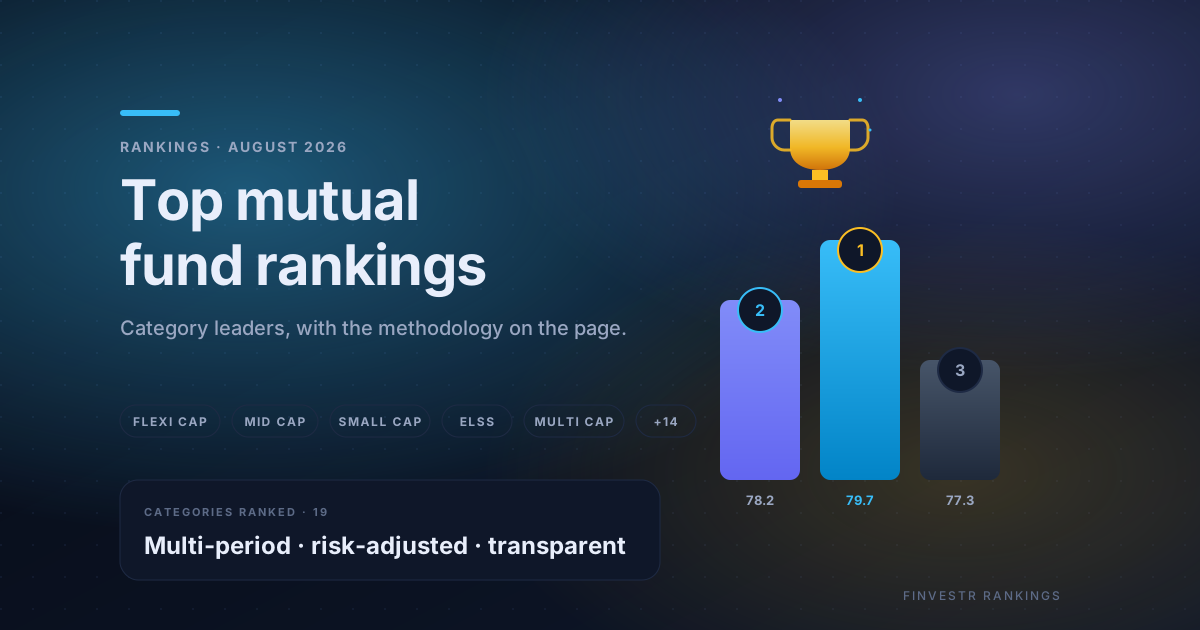
Top mutual fund rankings: August 2026
Our August 2026 category-wise mutual fund rankings, with 1Y, 3Y, 5Y, Sharpe 3Y and a final score for every top-5 fund. Methodology on the page.
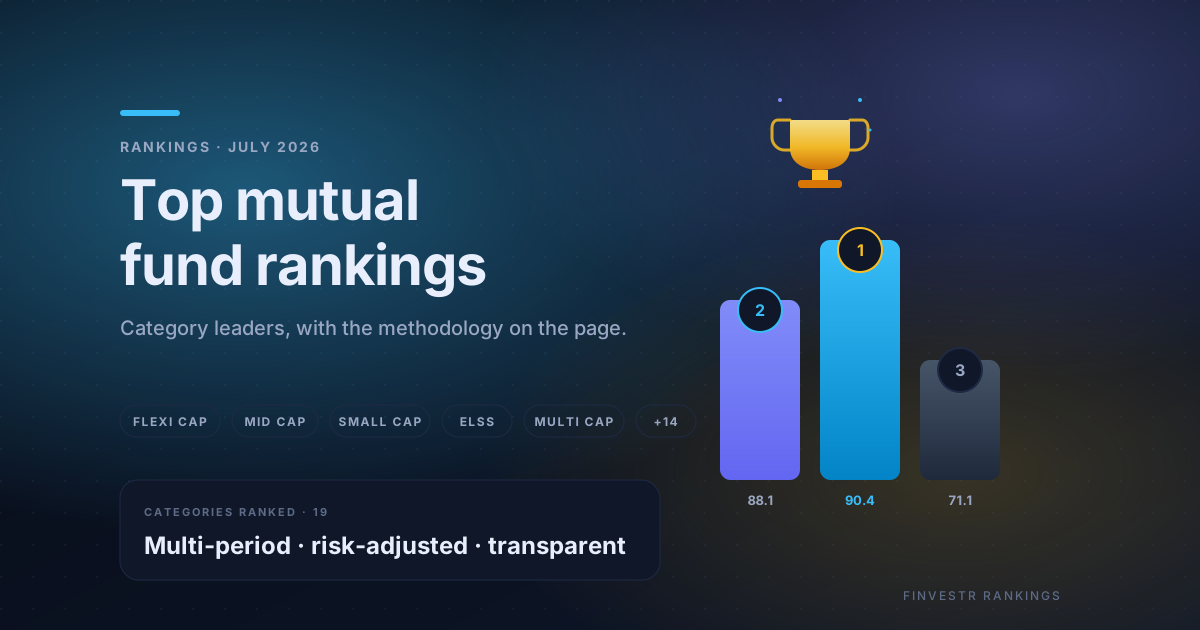
Top mutual fund rankings: July 2026
Our July 2026 category-wise mutual fund rankings, with 1Y, 3Y, 5Y, Sharpe 3Y and a final score for every top-5 fund. Methodology on the page.
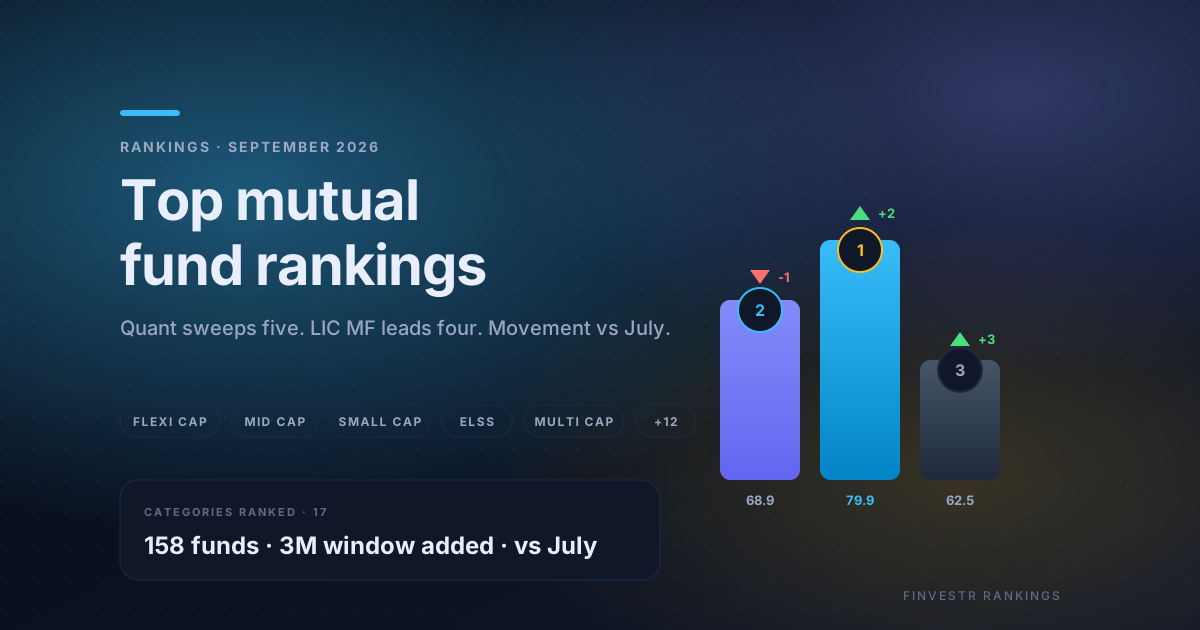
Top mutual fund rankings: September 2026
Our September 2026 category-wise mutual fund rankings, with 3M, 1Y, 3Y, 5Y, Sharpe 3Y and a final score for every top-5 fund. Quant and LIC MF dominate the movers.