Is your mutual fund portfolio over-diversified?
The four practical checks for over-diversification: count the funds, look at AMC overlap, measure category overlap, and check if your top 3 funds are doing all the work. With a worked example and a fix.
In this guide
- 1Count your funds and your categories. The simplest over-diversification check. An Indian retail portfolio that needs 4-6 funds in 2-3 categories has hit the sweet spot. A portfolio that has 10+ funds across 5+ categories is almost always over-diversified, paying 5-10 expense ratios for the same exposure it could get with 3-4.
- 2Check AMC overlap, not just fund count. Two top-ranked funds from the same AMC, run by the same fund manager, often behave like one fund. Three funds from HDFC, regardless of category, usually share 50-60% of the underlying stocks. The check: for each pair of funds in your portfolio, compute the AMC overlap.
- 3Measure category overlap, not just fund count. A Nifty 50 index fund, a large-cap fund, and a flexi-cap fund from the same house often have 60-80% stock overlap. The categories sound different; the underlying portfolios are not. The check: for each pair of funds, compute the stock-level overlap.
- 4Check if your top 3 funds are doing all the work. The most under-appreciated over-diversification check. In most 8+ fund portfolios, the top 3 funds by corpus contribution account for 70-80% of the total value, and the bottom 5 funds collectively account for 15-20%. The bottom 5 are also the funds that were added as 'satellite' or 'tactical' and have since been forgotten. They are paying expense ratios for almost no return contribution.
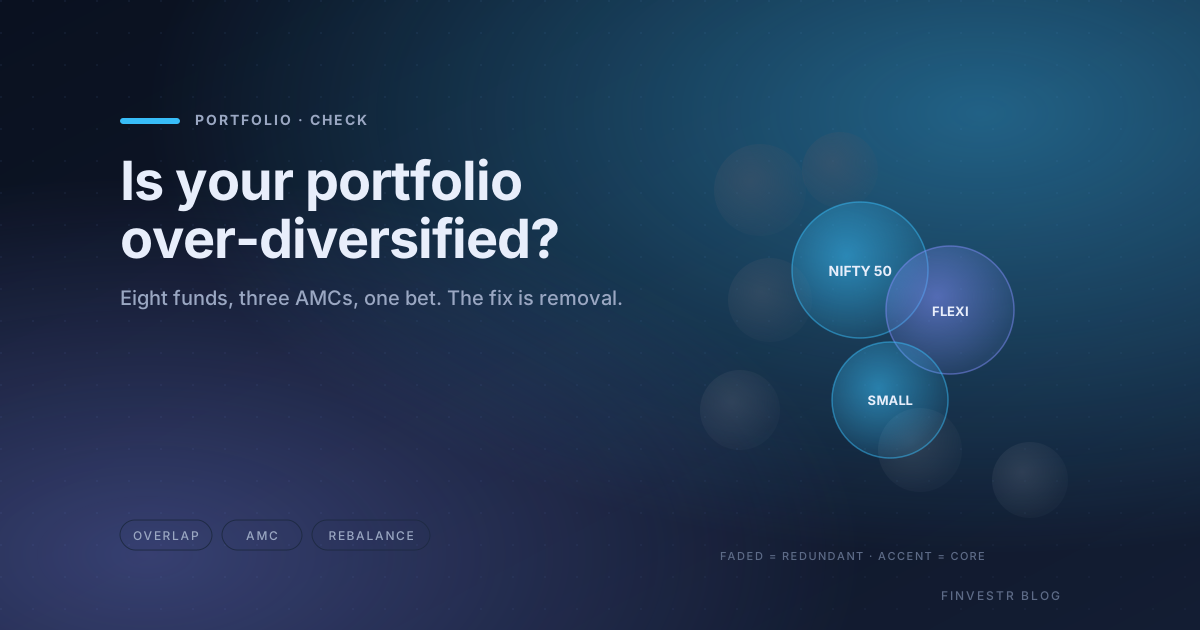
The most common Indian retail portfolio in 2026 looks like this: eight mutual funds, three AMCs, four SEBI categories, and a quiet suspicion that the investor is paying too many expense ratios for what the portfolio is actually doing. The investor is almost always right.
Over-diversification is the under-discussed twin of under-diversification. Both are mistakes. The first is solved by adding a fund. The second is solved by removing one. The trouble with the second is that adding a fund feels productive. Removing one feels like a loss. So the portfolio grows, year by year, until the marginal fund is contributing almost nothing to the return and the investor is paying 8 expense ratios for a portfolio that is functionally 2-3 bets.
This post is the four practical checks for over-diversification, with a worked example and a fix. None of them require a Bloomberg terminal. All of them require opening your CAS.
What over-diversification actually costs
The most expensive thing about over-diversification is not the extra expense ratios. It is the false sense of safety. A portfolio with 8 funds, all in the Indian large-cap or flexi-cap space, looks diversified on paper. It is not. The 8 funds are buying the same 50-100 stocks, often from the same 2-3 fund management houses. The portfolio's behaviour is the behaviour of one bet on Indian large caps, multiplied by 8 expense ratios.
In 2026 terms, the cost of 8 large-and-mid-cap funds vs 2 is roughly 0.6-0.9% per year in extra expense ratio. Over 20 years, on a ₹50L portfolio compounded at 12%, that is roughly ₹12-18L of foregone corpus. Not catastrophic, but real. The larger cost is the false sense of safety: an investor holding 8 funds is unlikely to notice that 6 of them are duplicating the same bet, and is unlikely to consolidate.
Check 1: count the funds and the categories
The simplest check. An Indian retail portfolio that needs 4-6 funds in 2-3 categories has hit the sweet spot. A portfolio that has 10+ funds across 5+ categories is almost always over-diversified.
The right number for a typical retail investor:
- 1 Nifty 50 index fund or large-cap fund (the core, 50-60% of equity)
- 1 flexi-cap fund (active management, 25-30% of equity)
- 1 mid-cap or small-cap fund (the growth kicker, 10-20% of equity)
- 1-2 debt funds (the safety sleeve, sized to the goal)
- Optional: 1 ELSS (if you need the 80C sleeve)
That is 4-6 funds across 3-4 categories. Anything above 8 funds is almost always over-diversified. Anything above 12 funds is structural over-diversification, and the only honest answer is to consolidate.
The FinvestR-Agent runs this check automatically. On every CAS upload, the agent counts the funds, lists the categories, and flags any portfolio with more than 6 equity funds or 3 active SEBI categories.
Check 2: check AMC overlap, not just fund count
Two top-ranked funds from the same AMC, run by the same fund manager, often behave like one fund. Three funds from HDFC, regardless of category, usually share 50-60% of the underlying stocks. The portfolio looks diversified on paper (3 funds, 3 categories) but the actual stock exposure is concentrated in one house.
The right rule: no more than 2 funds per AMC in the core portfolio. If you have HDFC Large Cap + HDFC Flexi Cap + HDFC Mid Cap, that is one fund manager's view of the market across three categories, not three independent bets. The fix: pick the best fund per AMC across categories, not the best fund per category without thinking about the AMC.
A common 2026 mistake: an investor who reads that HDFC Flexi Cap is a top-ranked fund and Parag Parikh Flexi Cap is also a top-ranked fund, and holds both, plus HDFC Large Cap, plus HDFC Mid Cap. That is 4 funds, 3 from HDFC, and the 3 HDFC funds share roughly 60% of their holdings. The portfolio is functionally 2 funds (HDFC cluster + Parag Parikh), with the HDFC cluster paying 3 expense ratios.
The fix: keep Parag Parikh Flexi Cap, keep the best HDFC fund (probably the Flexi Cap), and redeem the other two. The post-rebalance portfolio is 2 funds, 2 AMCs, 2 categories, and a meaningfully lower expense ratio.
Check 3: measure category overlap, not just fund count
A Nifty 50 index fund, a large-cap fund, and a flexi-cap fund from the same house often have 60-80% stock overlap. The categories sound different; the underlying portfolios are not.
Practical rules for category overlap:
- An index fund and an active fund in the same category should overlap at 80-90% by design. That is fine if you are deliberately using the index as a benchmark and the active fund as a high-conviction overlay. It is not fine if you thought you were getting two different bets.
- A flexi-cap and a multi-cap from the same house usually overlap 50-70%. That is too high. Pick one.
- A flexi-cap and a mid-cap from the same house usually overlap 30-50%. That is the right amount. Both funds are doing real work.
- A flexi-cap and a small-cap should overlap less than 25%. If the overlap is higher, the flexi-cap manager is reaching down the market-cap spectrum, or the small-cap manager is reaching up, and the two funds are functionally the same.
The FinvestR-Agent computes stock-level overlap for every pair in your portfolio using the latest factsheet holdings. The agent flags any pair with more than 60% stock overlap and the same AMC as 'functionally one fund', and ranks the pairs by overlap so the worst offenders are at the top.
Check 4: check if your top 3 funds are doing all the work
The most under-appreciated over-diversification check. In most 8+ fund portfolios, the top 3 funds by corpus contribution account for 70-80% of the total value, and the bottom 5 funds collectively account for 15-20%. The bottom 5 are also the funds that were added as 'satellite' or 'tactical' and have since been forgotten. They are paying expense ratios for almost no return contribution.
The right test: if you removed any one fund from the portfolio, would the portfolio's behaviour change meaningfully? If yes, the fund is doing real work. If no, the fund is duplicating exposure.
The FinvestR-Agent computes the 'marginal contribution' of each fund: how the portfolio's risk and return would change if that fund were removed. A fund with marginal contribution near zero is a redundancy. The agent flags these and suggests which to keep, with the tax impact of the redemption calculated.
The right portfolio for most retail investors has 3-5 funds, each with a meaningful allocation (at least 10% of the equity corpus), and each one is there for a reason that the investor can articulate. If you cannot explain why a fund is in the portfolio, it is a candidate to exit.
A worked example: the 8-fund trap
A real portfolio, with names redacted:
| Fund | Category | AMC | Current value | % of total |
|---|---|---|---|---|
| A | Flexi Cap | HDFC | ₹8,50,000 | 28% |
| B | Large Cap | HDFC | ₹5,40,000 | 18% |
| C | Mid Cap | HDFC | ₹3,20,000 | 11% |
| D | Flexi Cap | Parag Parikh | ₹4,80,000 | 16% |
| E | Small Cap | Nippon | ₹2,90,000 | 10% |
| F | ELSS | Motilal Oswal | ₹1,80,000 | 6% |
| G | Liquid | HDFC | ₹1,20,000 | 4% |
| H | Arbitrage | ICICI | ₹1,20,000 | 4% |
The diagnosis, by check:
- Count: 8 funds, 5 equity categories, 2 debt. Slightly over the 4-6 fund sweet spot.
- AMC overlap: 4 funds from HDFC, 1 from Parag Parikh, 1 from Nippon, 1 from Motilal Oswal, 1 from ICICI. HDFC concentration is 57% of the corpus. The 3 HDFC equity funds share 60% of their holdings, meaning roughly 35% of the portfolio is one fund manager's view of the market.
- Category overlap: A (HDFC Flexi Cap) and B (HDFC Large Cap) overlap ~70%. A and C (HDFC Mid Cap) overlap ~50%. D (Parag Parikh Flexi Cap) and A (HDFC Flexi Cap) overlap ~40% (different AMCs, so this is a real pair).
- Top 3 work: A + B + D = 62% of the corpus. The bottom 5 (C + E + F + G + H) collectively make up 35% of the corpus, with the bottom 2 (G + H) at 8%. G and H are the redundancy candidates.
The fix:
- Keep A (HDFC Flexi Cap) and D (Parag Parikh Flexi Cap). These are the two real flexi-cap bets, from different AMCs.
- Keep E (Nippon Small Cap). This is the growth kicker, from a third AMC.
- Keep B (HDFC Large Cap), because it provides a low-volatility ballast to the flexi-cap pair. Total HDFC exposure drops from 4 funds to 1, total HDFC corpus share drops from 57% to 18%.
- Redeem C (HDFC Mid Cap). The overlap with A is 50%, and the marginal contribution is low. Tax impact: ₹42,000 LTCG above the ₹1.25L exemption at 12.5% = roughly ₹5,200.
- Redeem F (Motilal Oswal ELSS). Marginal contribution is low, and the 80C question is best answered by holding 1 ELSS for the duration, not adding a 6% allocation satellite. Tax impact: minimal, the fund is small and recently purchased.
- Redeem G (HDFC Liquid) and H (ICICI Arbitrage). Both are tiny, both duplicate the same job, and the cash is better redeployed into a single liquid fund or held as a cash buffer.
Post-rebalance portfolio: 4 funds, 3 AMCs, 3 equity categories, no redundancies. The expense ratio drops from roughly 0.85% blended to 0.55% blended. The portfolio behaviour is materially the same, with less drag.
The over-diversification checklist
A four-step routine for any Indian retail portfolio:
- Count. How many funds, how many categories? Above 6 equity funds is a yellow flag, above 10 is a red flag.
- AMC overlap. More than 2 funds from one AMC, especially in the same category, is almost always over-diversification. Pick the best fund per AMC.
- Category overlap. For each pair, what is the stock-level overlap? Above 60% in the same AMC is a redundancy.
- Top 3 work. Do the top 3 funds hold 75%+ of the corpus? If yes, the bottom 5 are candidates to exit or consolidate.
Run this every January, alongside the step-up. The portfolio should get smaller, not larger, over time. The early years are about building positions. The later years are about pruning.
The takeaway
Over-diversification is the silent under-discussed mistake in Indian retail portfolios. It looks like safety. It feels productive. It pays 5-10 expense ratios for what is structurally 2-3 bets. The cost is not just the extra fees. It is the false sense of diversification that prevents the investor from noticing the actual concentration.
The right portfolio for most Indian investors has 4-6 funds in 2-3 categories, no more than 2 funds from one AMC, and every fund doing real work that the investor can articulate. Anything else is over-diversification, and the fix is to remove, not add.
The FinvestR-Agent runs all four checks on every CAS upload, with the marginal contribution of each fund, the stock-level overlap for every pair, and the tax impact of every recommended exit. The annual January rebalance is one click. The whole point of the agent is to make the right-sized portfolio the path of least resistance, not the path of most resistance.
What to read next
- Best mutual funds to invest in India 2026 - the pillar shortlist, with the top pick per category, the right starting point for a right-sized portfolio.
- How to start investing in mutual funds in India - the 10-minute flow for going from zero to your first SIP, with a 3-fund starter portfolio.
- XIRR vs CAGR vs Absolute Returns - how to read the return number on the consolidated portfolio, which is the only way to know if the consolidation actually helped.
- The FinvestR living portfolio - what an actively managed, fully-transparent MF portfolio looks like in practice, including the annual rebalance.
- How much you actually need to retire in India - the corpus math, which the right-sized portfolio is in service of.
- The monthly mutual fund rankings - the live top-10 in every category, for when the rebalance calls for a new top-quartile pick.
Frequently asked questions
How many mutual funds should I have in my portfolio?▾
For a typical Indian retail investor, 4-6 funds is the right number. The breakdown usually looks like: 1-2 equity index or large-cap funds (the core, 50-60% of equity), 1 flexi-cap fund (active management, 25-30%), 1 mid or small-cap fund (the growth kicker, 10-20%), and 1-2 debt funds (the safety sleeve, sized to the goal). Anything above 8 funds is almost always over-diversified. The FinvestR-Agent runs the count and the overlap on every CAS upload and flags any portfolio that has more than 6 funds or more than 3 active categories.
What is the difference between diversification and over-diversification?▾
Diversification is owning funds that are not correlated, so a bad year in one category is offset by a good year in another. Over-diversification is owning so many funds that the portfolio ends up correlated anyway, and you are paying 5-10 expense ratios for the same single bet. The test: if you removed any one fund from the portfolio, would the portfolio's behaviour change meaningfully? If yes, the fund is doing real work. If no, the fund is duplicating exposure. The FinvestR-Agent computes the 'marginal contribution' of each fund: how the portfolio's risk and return would change if that fund were removed. A fund with marginal contribution near zero is a redundancy.
How do I measure overlap between two mutual funds?▾
The cleanest measure is the stock-level overlap: the number of stocks that both funds hold, weighted by the size of the holding. Two funds that hold the same 10 stocks but in different weights have a different overlap from two funds that hold the same 30 stocks in identical weights. The FinvestR-Agent computes this for every pair in your portfolio using the latest factsheet holdings. A simpler proxy: if both funds track the same index (e.g. two Nifty 50 funds), the overlap is 95%+. If both are large-cap funds from the same house, the overlap is typically 60-80%. If they are from different categories (e.g. a flexi-cap and a small-cap), the overlap is typically 20-40%.
Is 4-5 funds in the same category over-diversified?▾
Yes, almost always. If you have 4-5 flexi-cap funds, the marginal contribution of the 4th and 5th is close to zero, because they are all buying the same 50-100 stocks. You are paying 4-5 expense ratios (0.6-1.5% per year) for one bet on the Indian large-and-mid-cap market. The right number per category is one fund (or two, if you want a core + satellite structure, e.g. an index fund plus an active fund). Anything more is over-diversification.
What about the FinvestR-Agent overlap check?▾
The FinvestR-Agent computes three overlap measures for every pair of funds in your portfolio. Stock-level overlap (using the latest factsheet holdings), AMC overlap (whether the two funds share a fund manager and a house view), and category overlap (whether the two funds are in the same SEBI category or in different categories that often hold the same stocks, like a large-cap and a flexi-cap). Any pair with more than 60% stock overlap and the same AMC is flagged as 'functionally one fund'. The agent then suggests which of the two to keep and which to redeem, with the tax impact calculated.
Should I have funds from different AMCs?▾
Yes, for the core equity allocation. Two funds from the same AMC, especially if they share a fund manager, behave like one fund. The right structure: 1 fund from one AMC for the core (Nifty 50 index or large-cap), 1 fund from a different AMC for the flexi-cap allocation (a different fund manager, a different house view), 1 fund from a third AMC for the mid or small-cap. The point is not to maximise AMC count (3 AMCs is plenty for a 4-6 fund portfolio), it is to avoid concentration in one house. The FinvestR-Agent computes AMC overlap and flags any portfolio where more than 50% of the equity corpus is in one AMC.
What if I have inherited a portfolio from someone else?▾
Inherited portfolios are usually over-diversified. The previous holder added funds over the years for specific goals that are no longer relevant, and never consolidated. The right approach: do a full audit, list every fund with its current value, its category, its AMC, and its 5Y return, and decide which ones to keep. The decision rule: keep the top 4-6 funds by 5Y return, diversified across categories and AMCs, and redeem the rest. Use the proceeds to top up the funds you are keeping, or to start a new SIP in the category that was missing. The FinvestR-Agent runs the inherited-portfolio audit in one click: it ranks every fund, flags the redundancies, and computes the tax impact of the recommended redemptions.
How often should I rebalance an over-diversified portfolio?▾
Once a year, in January, as part of the step-up. Selling funds triggers capital gains tax, and churn is expensive. The right rhythm: every January, run the overlap check, sell the bottom 1-2 funds by 5Y return (or by marginal contribution), and add the proceeds to the top fund in the same category if there is one, or to a fund in a category that was missing. The FinvestR-Agent automates this: it produces the annual rebalance plan in one click, with the tax impact and the post-rebalance portfolio summary.
See your portfolio the way it should be seen.
Try the 1-min Goal CheckRelated reading
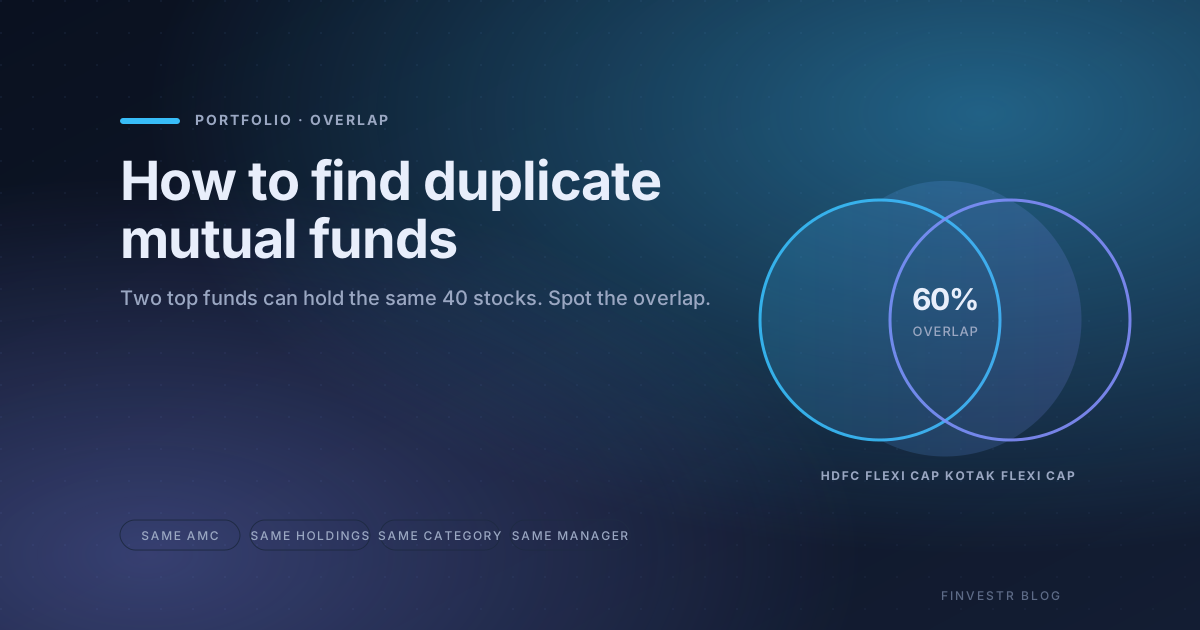
How to Find Duplicate Mutual Funds in Your Portfolio
The four ways duplicate funds sneak into an Indian portfolio, how to spot them by AMC, category, top holdings, and fund manager, and how to consolidate to a leaner, cheaper set.

Why you don't need SIF in your portfolio
A sharp look at SIF, SEBI's new long-short product, and why its capped-upside payoff is the last thing you want after two flat years in equity mutual funds.
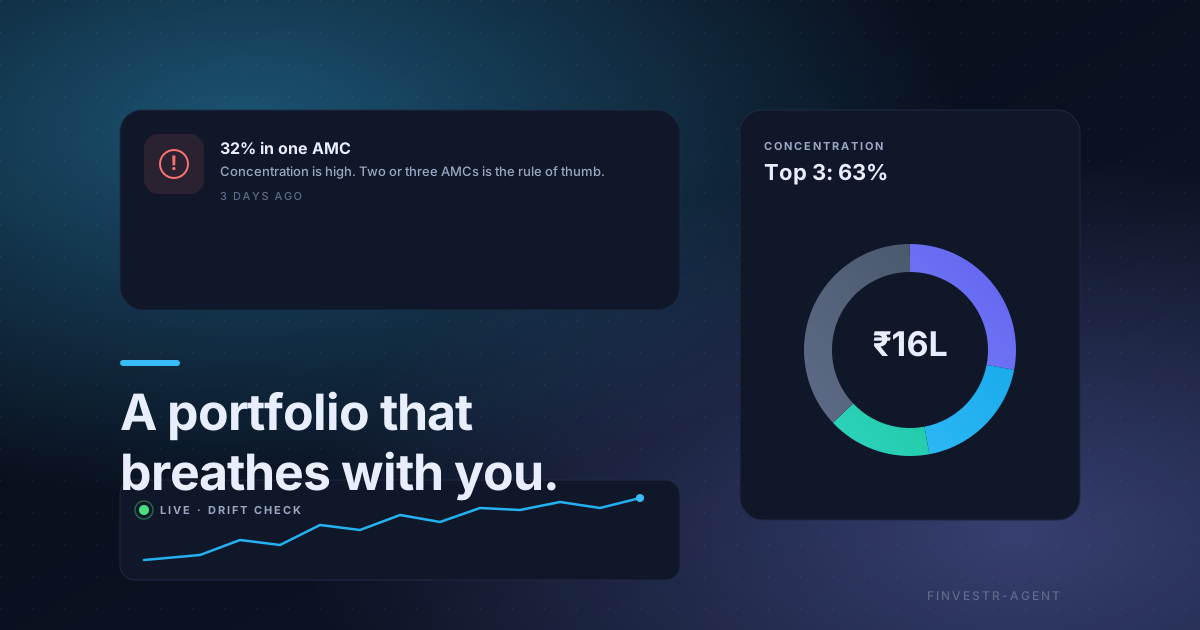
Your portfolio is alive. Your agent is too.
What 'alive' actually means for a mutual fund portfolio, the daily signals we ship, and why on-device CAS parsing matters.