Mutual Fund vs FD: Which is better for you in 2026?
A side-by-side of FDs and equity mutual funds in 2026, with the after-tax return, the inflation-adjusted return, and the right answer for every goal from a 1-year emergency fund to a 15-year retirement SIP.
In this guide
- 1Decide the goal and the horizon first. The right answer to 'FD or mutual fund' depends almost entirely on when you need the money. A 1-year goal is a different question from a 15-year goal, and the right product for each is different.
- 2Compute the after-tax return of an FD. An FD's headline rate is not your return. Three drags apply: TDS (Tax Deducted at Source) above the ₹40,000 interest threshold for non-senior citizens (₹50,000 for senior citizens), your slab-rate income tax on the full interest, and inflation.
- 3Compute the after-tax return of an equity mutual fund. Equity mutual fund returns are taxed under Section 50 of the Income Tax Act, not your slab. The post-July 2024 regime: 20% STCG (Short Term Capital Gains, units held under 1 year) and 12.5% LTCG (Long Term, over 1 year) on gains above ₹1.25 lakh per financial year. Dividends are taxed at your slab rate.
- 4Pick the FD for capital protection, the liquid fund for the same job at a higher return. An FD has one job: protect the principal. A bank FD is insured up to ₹5 lakh per bank per depositor by DICGC (Deposit Insurance and Credit Guarantee Corporation). A liquid mutual fund is not insured, but its underlying portfolio is short-tenure government securities, bank CDs (Certificates of Deposit), and commercial paper, and the return is roughly 0.5-1.5% above the best FD rate, with daily liquidity.
- 5Pick the equity mutual fund for any goal 5+ years away. For a 10-15 year goal, equity mutual funds are the only asset class that has historically beaten inflation by 5-6 percentage points a year in India. The FD cannot do this. The PPF cannot do this (returns are capped near 7%). The gold bond cannot do this (gold compounds at 8-10% long-term, mostly via rupee depreciation).
Every month, the same conversation shows up in every Indian household. Park ₹5 lakh in an FD at 7.5%, or start an SIP in a mutual fund at 12%? The FD feels safe. The mutual fund feels risky. Most families end up in the FD, and ten years later they realise the corpus has lost to inflation.
This post is the 2026 version of that conversation, with the tax math, the inflation math, and the actual numbers for every goal from a 1-year emergency fund to a 25-year retirement SIP. The short answer: an FD and a mutual fund are not the same tool. They are not even in the same category. The right product depends on the goal and the horizon, and using the wrong one for the wrong goal is the most common, most expensive mistake in Indian personal finance.
The two products are not competitors
An FD has one job: protect your principal. A bank FD is insured up to ₹5 lakh per depositor per bank by DICGC (Deposit Insurance and Credit Guarantee Corporation, the body that insures your bank deposits). The interest is a small premium for letting the bank use your money. In exchange, you get certainty. The corpus at maturity is known to the rupee.
A mutual fund, specifically an equity mutual fund, has a different job: grow your principal above inflation. There is no insurance. The NAV (Net Asset Value, the per-unit price of a fund) can fall 30-40% in a bad year. Over a 5+ year horizon, the return is meaningfully higher than the FD, but the path is volatile.
Treating the FD and the equity mutual fund as a binary choice is the mistake. They are complements. The right portfolio has both, sized to the goal.
The 2026 FD: what you actually earn
Headline FD rates in mid-2026 are roughly 7-7.75% for a 5-year deposit at a PSU bank (Public Sector Undertaking bank, a government-owned bank like SBI, PNB, BoB). Senior citizens get an extra 0.5%. The 7.5% number is what every bank ad quotes, but it is the number that has not been taxed yet.
Three drags apply, and they are heavy.
The hidden cost of an FD in 2026:
- TDS at 10% on interest above ₹40,000 in a year (₹50,000 for senior citizens). The TDS is a deposit, not a tax. You still owe the full slab-rate tax on the interest.
- Slab-rate income tax on the full interest. There is no indexation benefit since April 2023.
- Inflation, which has averaged 5-6% in India over the last decade and runs higher for healthcare and education.
Worked example. You book a ₹10 lakh, 5-year FD at 7.5% as a 30-year-old in the 30% tax slab. Over 5 years, the FD pays ₹4.61L in headline interest. After 30% tax, you keep ₹3.23L. The real value of that ₹3.23L, after 6% inflation, is ₹1.31L in today's money. The pre-tax headline of 7.5% per year, compounded over 5 years, becomes a post-tax, post-inflation CAGR of roughly 2.3% per year.
The FD did not lose your money. It lost your purchasing power, slowly and quietly, at a rate that is not visible on the statement.
The 2026 equity mutual fund: what you actually earn
The same ₹10 lakh, deployed as a 5-year lump sum into a Nifty 50 index fund, does something different. A 12% pre-tax return compounds to ₹17.62L over 5 years. Gains above ₹1.25L per financial year are taxed at 12.5% LTCG (Long Term Capital Gains, the tax on equity profits held over 1 year). For a 5-year lump sum with no withdrawals, the LTCG is roughly ₹5.96L, taxed at 12.5%, leaving a post-tax gain of ₹5.21L. The post-tax corpus is ₹15.21L. After 6% inflation, the real value is ₹11.34L in today's money. The effective real CAGR is roughly 4.3% per year.
Wait, that is barely better than the FD's 2.3%. The reason: a 5-year lump sum is a short window, and the equity fund's last 2 years were flat. The longer the horizon, the wider the gap. The 12% pre-tax / 4.3% real at year 5 becomes 12% / 5.5% real at year 10 and 12% / 5.8% real at year 20. The compounding is back-loaded, because the market compounds and the FD's rate is roughly constant.
The crossover, by horizon
Plotting both products over 1, 3, 5, 10, and 20-year horizons, with the same tax slab and the same inflation assumption, gives a clear picture.
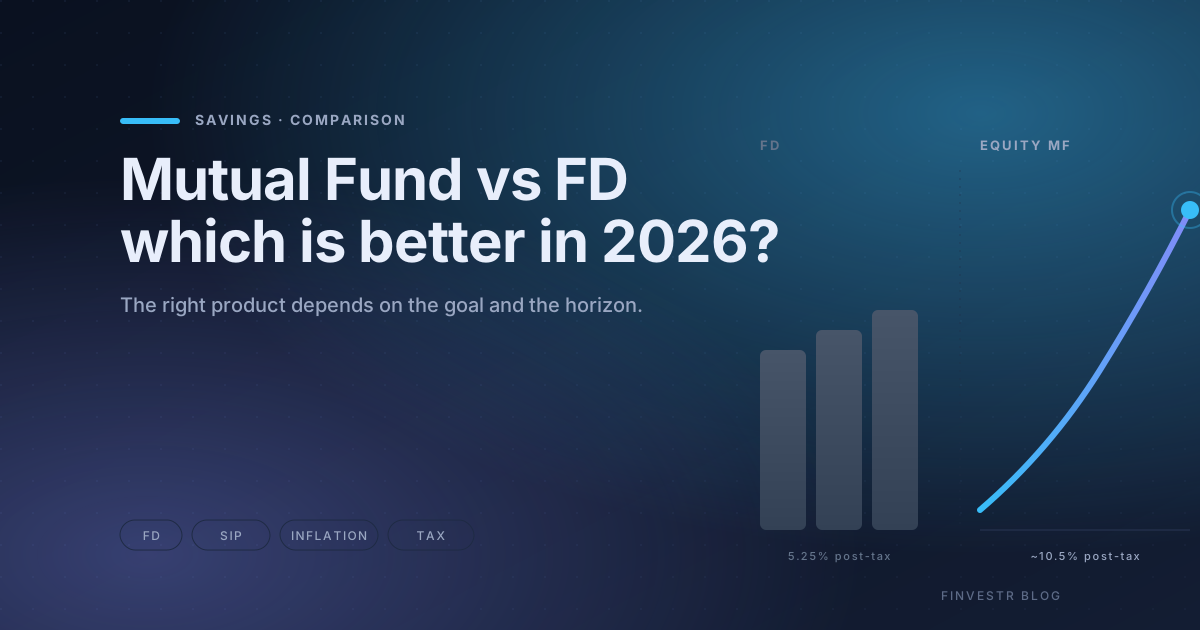
For a 1-year goal, the FD wins, hands down. The FD's 5.25% post-tax is positive, and an equity fund in a single year can be negative. The 1-year goal belongs in an FD or a liquid fund.
For a 3-year goal, the FD still wins on a risk-adjusted basis. The 3-year window is too short to reliably recover from a market drawdown. The right product for a 3-year goal is a balanced advantage fund or a short-duration debt fund, not an equity fund and not a 5-year FD (which has an exit penalty).
For a 5-year goal, the two are roughly tied on post-tax, post-inflation return, with the FD winning on stability and the equity fund winning on upside if the market cooperates. The deciding factor is your tax slab: in the 30% slab, the equity fund's 12.5% LTCG vs the FD's 30% slab tax on interest is a 17.5-point tax gap. The equity fund's 12% pre-tax return is structurally more efficient than the FD's 7.5% in the 30% slab.
For a 10-year goal, the equity fund wins on every metric that includes inflation. The real CAGR gap is 3-4 percentage points. For a 20-year goal, the equity fund wins by 4-5 percentage points, and the corpus difference is large in absolute terms. For a 25-year retirement SIP, the corpus difference is roughly 2-3x.
The four FD use cases that still make sense
The FD is not obsolete. There are four jobs only an FD can do, and they are the four jobs the FD is built for.
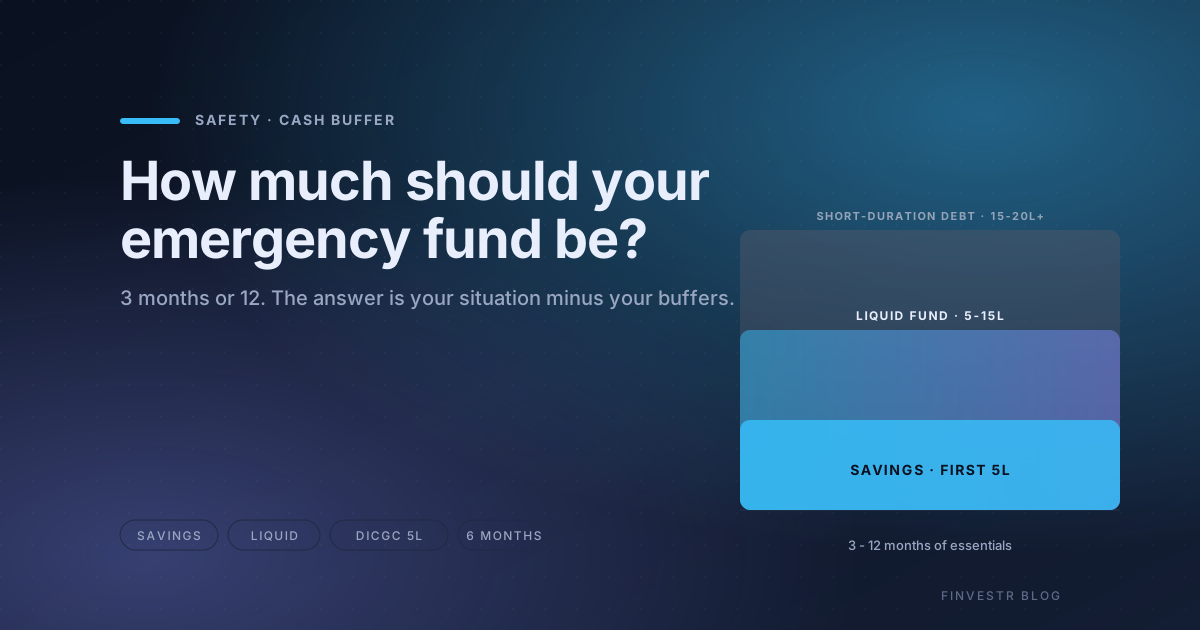
The emergency fund above ₹5 lakh. The first ₹5L of your emergency fund should be in a savings account or liquid fund for daily access. Anything above ₹5L (where DICGC insurance is the deciding factor) belongs in an FD, ideally in a separate bank from your primary account.
The 1-year goal. A tax payment, a known large purchase, a wedding contribution. Anything you will need in under 12 months, where any market dip would derail the goal. The FD's certainty is the entire point.
The 3-year band, with a senior-citizen or low-risk-tolerance investor. A short-duration debt fund is a better answer in pure return terms, but the FD's principal protection is the feature the investor is paying for. The trade-off is conscious, not accidental.
Income stability for retirees. For a retiree who needs a fixed monthly cash flow, the FD plus the SCSS (Senior Citizen Savings Scheme, 8.2% currently) plus the POMIS (Post Office Monthly Income Scheme, 7.4% monthly) is a legitimate income strategy. The right comparison is not 'FD vs equity fund'. It is 'stable monthly income vs growing corpus, and the right answer is both, sized to the need'.
The four places to never use an FD
The flip side: four places where the FD is the wrong product, regardless of how safe it feels.
Your 5+ year equity allocation. Putting your retirement SIP or your child's education corpus in an FD because 'MFs are risky' is the most expensive mistake in Indian personal finance. The post-tax, post-inflation return is structurally negative in low-tax slabs and only marginally positive in the 30% slab. The corpus is guaranteed to fall behind an equity SIP over any 10+ year window.
Your 'I will switch to equity when the market corrects' money. The market is not waiting for your entry. A 5-year FD booked in 2021 at 5.5% matured in 2026 with post-tax interest of ₹1.85L on ₹10L. The Nifty 50 in the same 5 years went from 15,000 to 24,000, a 60% pre-tax gain. The opportunity cost of waiting for the right entry point is consistently the largest cost in any investor's book.
Your child education goal at age 2. The corpus has 16 years. An FD compounding at 5.25% post-tax in the 30% slab for 16 years makes ₹2.27L on a ₹10L base. An equity fund compounding at 10.5% post-tax in the same window makes ₹4.95L. The corpus difference funds a year of college.
Your retirement, after age 50. The shift from equity to debt in the last 5-7 years before retirement is a real strategy, but the shift should be to a debt mutual fund, not to an FD. The debt fund has the same post-tax return (slab-rate, since April 2023) but better liquidity, no TDS hassle, and no exit penalty.
The right answer, by goal
Mapping the products to the goals in your financial plan:
- Emergency fund (1 year, 3-6 months of expenses): Savings account + liquid fund, not FD. Higher return, same liquidity.
- Goals under 1 year: FD, sweep-in FD, or liquid fund.
- 1-3 year goals: Short-duration debt fund or balanced advantage fund, not 5-year FD.
- 3-5 year goals: Balanced advantage fund, conservative hybrid fund, or a 60:40 equity:debt mix.
- 5-10 year goals: Flexi-cap or large-cap equity fund as the core, debt fund for any portion you cannot afford to lose.
- 10+ year goals: Equity mutual fund, full stop. The FD is the wrong product for this goal.
- Retirement (20+ year horizon): Equity SIP with annual step-up, transitioned to debt 5-7 years before retirement. No FDs in the equity phase.
The FD is a great product for the jobs it was built for. The mistake is using it for jobs it was not built for, specifically the long-horizon wealth creation that only equity can do.
The takeaway
The FD vs mutual fund question is not a binary. It is a portfolio construction question, and the answer depends on the goal and the horizon.
For any money you need in under 3 years, or any amount above the DICGC insurance ceiling that you cannot afford to lose, the FD (or a liquid fund) is the right product. For any goal 5+ years away, the equity mutual fund is the right product, and the FD is structurally the wrong one regardless of how safe it feels.
The math, in the 30% tax slab at 6% inflation, gives the equity fund a post-tax, post-inflation CAGR that is 3-4 points above the FD's over a 10-year horizon and 4-5 points above over a 20-year horizon. The gap, compounded over 25 years, is the difference between a ₹1.5 crore retirement corpus and a ₹67L one. That is the cost of choosing an FD over an equity fund for a long-horizon goal, and it is the most common avoidable loss in Indian personal finance.
For the right mix for your own goals, upload your CAS to the FinvestR-Agent or run the retirement planner. The agent will tell you which of your goals are sitting in the wrong product, and what the corpus difference would be if you moved them to the right one.
What to read next
- How to start investing in mutual funds in India - the 10-minute flow for going from zero to your first SIP.
- How much should your emergency fund be? - if you are not sure what sits in the savings-account + liquid-fund tier, this is the post.
- How much you actually need to retire in India - the corpus math for the long-horizon goal an FD cannot fund.
- XIRR vs CAGR vs Absolute Returns - how to actually read the return number on the FD vs the return number on the equity fund on a like-for-like basis.
- ELSS vs PPF - the 80C trade-off, which is a different comparison but a related one.
- Best mutual funds to invest in India 2026 - the pillar shortlist, with the top pick in every category.
- The monthly mutual fund rankings - the top funds in every category, refreshed monthly.
Frequently asked questions
Are mutual funds safer than FDs in 2026?▾
No, and they are not trying to be. An FD is insured up to ₹5 lakh per bank by DICGC. A mutual fund is not insured; its NAV (Net Asset Value, the per-unit price) can fall. The two products solve different problems. An FD protects principal. A mutual fund grows principal above inflation. If you need the money in under 3 years, or you cannot tolerate any chance of a loss, the FD (or a liquid fund) is the right product. If the goal is 5+ years away, the FD's inflation-adjusted return is negative and the equity fund is the right product despite the volatility.
Which gives better returns: FD or mutual fund?▾
Over a 5+ year horizon, equity mutual funds give meaningfully better returns than FDs, both before and after tax. A 12% equity return vs a 7.5% FD headline is already a 4.5 point gap. After the 30% slab tax on FD interest vs the 12.5% LTCG on equity, the gap widens to 5-6 points pre-inflation. After 6% inflation, the FD's real return is roughly 1-2% per year, and the equity fund's real return is 6-8%. The crossover is around year 3; below that, FDs win on stability; above that, equity funds win on wealth creation.
Is FD interest taxable?▾
Yes, fully taxable at your slab rate. Since April 2023, there is no indexation benefit on bank FD interest. TDS (Tax Deducted at Source) is 10% if interest exceeds ₹40,000 in a year (₹50,000 for senior citizens), but the full interest is added to your income and taxed at your slab rate at ITR filing. So a 30% slab investor earning 7.5% on an FD is actually earning 5.25% post-tax, and likely 0-1% post-inflation. The tax tail is the FD's biggest hidden cost.
Are mutual funds tax-free?▾
No, but they are taxed at a lower rate than FDs. Equity fund gains held over 1 year are taxed at 12.5% LTCG on gains above ₹1.25L per year. Debt fund gains (post-April 2023) are taxed at your slab rate, with no indexation. For an equity fund, this is the difference between a 9-10% post-tax return in the 30% slab and a 5.25% post-tax FD return. For a debt fund, the tax treatment is similar to an FD, so the choice between an FD and a debt fund is mostly about liquidity, not return.
What is the FD limit insured by DICGC?▾
Up to ₹5 lakh per depositor per bank. This covers both the principal and the accrued interest. So if you have ₹4L in an FD and ₹1.5L in a savings account at the same bank, the full ₹5.5L is insured (the deposit-insurance ceiling is on aggregate deposits, not on a per-account basis, up to ₹5L). For amounts above ₹5L, split across multiple banks. Mutual funds are not insured by DICGC; their safety is the underlying portfolio's credit quality.
Can I have both FD and mutual fund?▾
Yes, and most Indian investors should. The standard split: 3-6 months of expenses in a savings account or liquid fund (emergency fund), 1-3 years of goals in an FD or short-duration debt fund, and 5+ year goals in equity mutual funds. The mistake is putting the 5+ year goal in an FD for 'safety' and watching inflation eat the corpus. The two products are complements, not substitutes.
Which is better for a 3-year goal?▾
Neither an FD nor an equity fund is ideal for a 3-year goal. The 3-year horizon is the awkward middle band. FDs give certainty but lose to inflation. Equity funds can swing 30-40% in a bad year, and a 3-year window is too short to reliably recover. The right product for a 3-year goal is a balanced advantage fund (dynamic asset allocation, equity:debt mix shifts with valuations) or a short-duration debt fund. The FinvestR agent flags this exact case in your goal plan.
What about senior citizens? Is FD the best option?▾
For a senior citizen with no other income and a need for stable monthly cash flow, the FD plus the Senior Citizen Savings Scheme (SCSS) plus the Post Office Monthly Income Scheme (POMIS) is a legitimate income strategy. SCSS currently pays 8.2% to seniors, fully taxable, with a 5-year tenure. The Post Office scheme pays 7.4% monthly. For the portion of the corpus that does not need to generate monthly income, a debt mutual fund or a balanced advantage fund gives better post-tax, post-inflation returns than an FD. The choice is income stability vs corpus growth, not FD vs mutual fund as a binary.
See your portfolio the way it should be seen.
Try the 1-min Goal CheckRelated reading
How much should your emergency fund be in India?
How many months of expenses belong in an emergency fund, where to park it (savings account, liquid fund, short-duration debt fund), and why the standard 3-6 months rule is wrong for most Indian households.
How to start investing in mutual funds in India (2026)
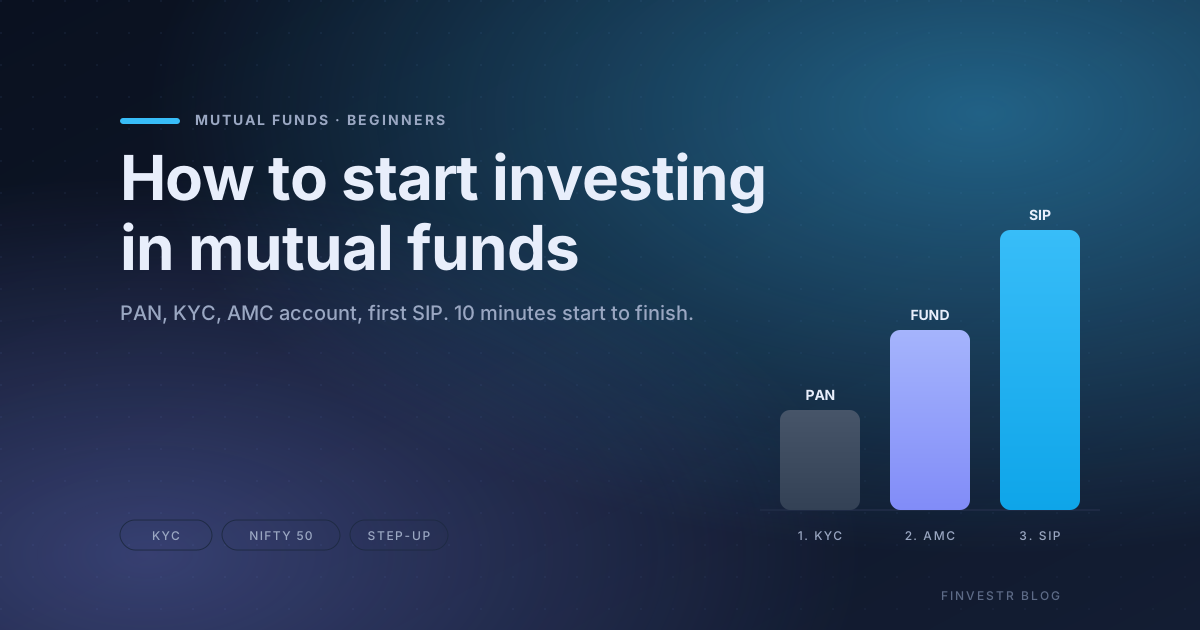
Everything you need to go from zero to your first SIP: KYC, PAN, picking an AMC, choosing a fund, automating the SIP, and the three funds most beginners actually need to start with.
How much do you actually need to retire in India?
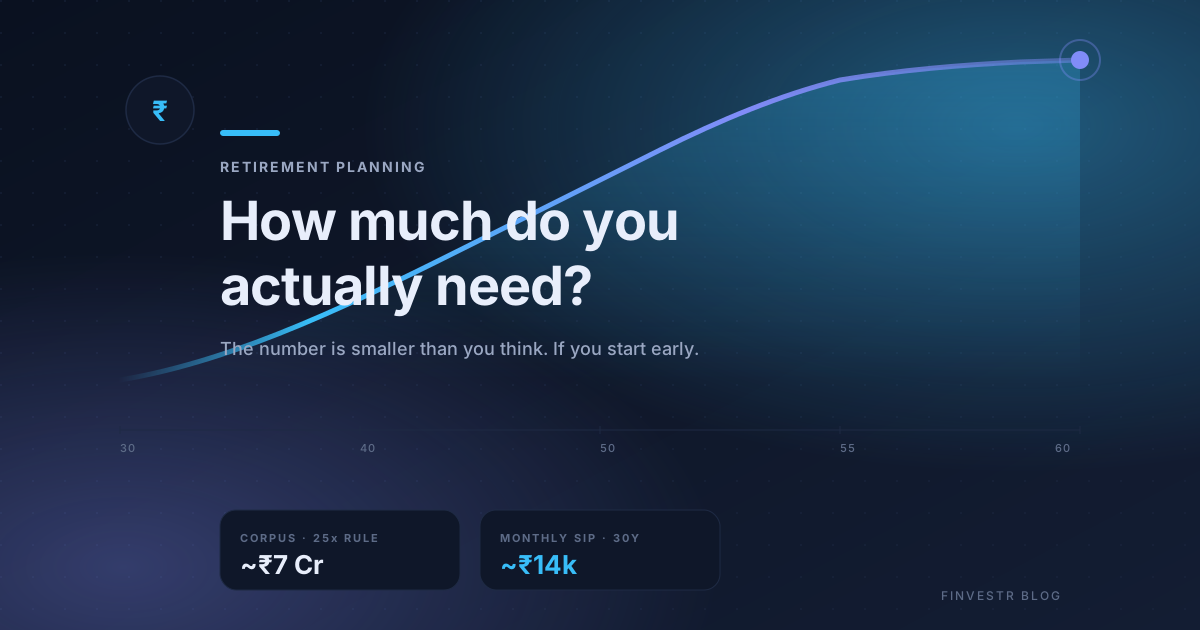
A practical breakdown of the math behind a retirement corpus, from expenses to inflation to the SIP that gets you there.