How to start investing in mutual funds in India (2026)
Everything you need to go from zero to your first SIP: KYC, PAN, picking an AMC, choosing a fund, automating the SIP, and the three funds most beginners actually need to start with.
In this guide
- 1Get your KYC and PAN in order. KYC (Know Your Customer) is a one-time identity verification every Indian investor must complete before investing in any mutual fund. You do it once, it stays valid for life.
- 2Open an AMC account (or a single demat account). An AMC account is free and is where your mutual fund units are held. You can open one with each AMC individually (HDFC, ICICI Prudential, SBI, Nippon, etc.) or hold all of them inside a single demat account with a broker like Zerodha, Groww, or Kuvera.
- 3Pick your first fund. A common beginner mistake is to start with five funds across five categories. Resist that. Start with one large-cap index fund, one flexi-cap fund, and (only if you are under 35 with a 10+ year horizon) one small-cap or mid-cap fund.
- 4Decide your SIP amount and date. A Systematic Investment Plan (SIP) is a fixed amount debited from your bank account on a fixed date every month. The magic of a SIP is not the return, it is the rupee-cost averaging: you buy more units when the NAV is low and fewer when it is high.
- 5Set up the SIP and your first lump sum. Most AMC apps and brokers let you set up a SIP in 2 minutes. You pick the fund, the amount, the date, and the duration (forever, or a fixed number of months).
- 6Track the portfolio, not the noise. After month 1, you will not need to do anything. The SIP runs on its own. The mistake most beginners make is to check the NAV every day, panic on a 5% drawdown, and stop the SIP. That is exactly the wrong move.
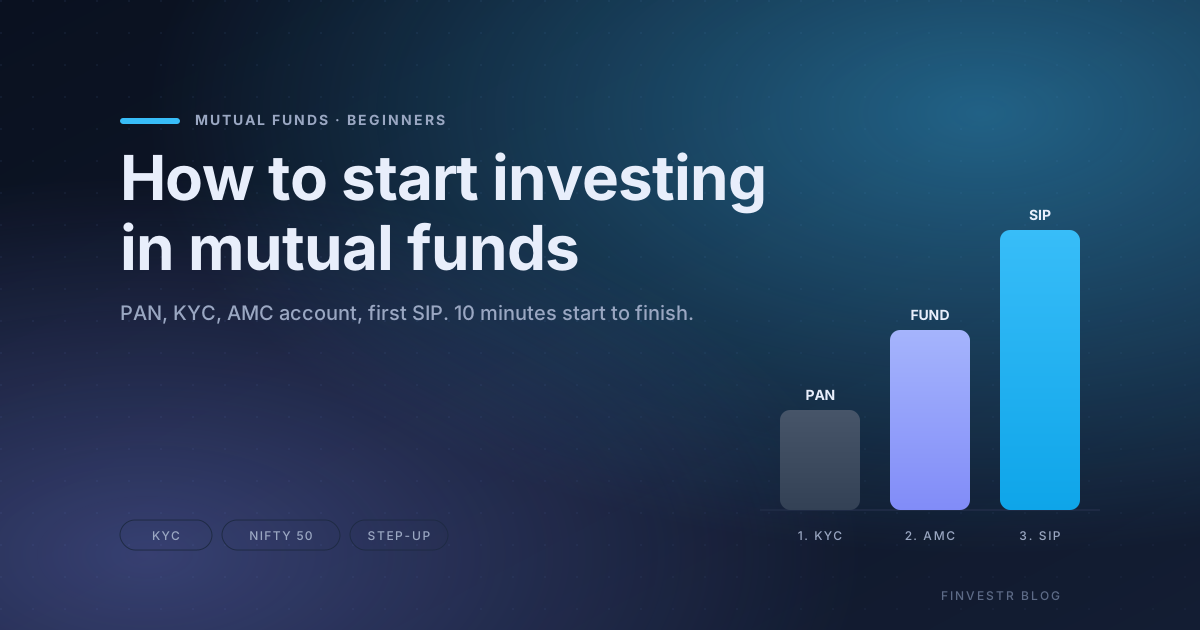
You don't need a finance degree, a broker, or a lump sum of ₹5 lakh. You need a PAN card, an Aadhaar-linked mobile number, a bank account, and about 10 minutes. The rest of this post is exactly those 10 minutes, with the traps to avoid at each step.
If you read one Indian-investing guide this year, read this one. The flow below is the same flow we walk new clients through on day one.
Step 1: Get your KYC and PAN in order
KYC (Know Your Customer) is a one-time identity check that every Indian investor must complete before any AMC (Asset Management Company, the company that runs a mutual fund) can onboard you. You do it once, it stays valid for life across every AMC and every fund.
If you have a PAN card and your mobile number is linked to Aadhaar, you can finish eKYC in under 10 minutes through any AMC website or app. The four things you need:
- PAN card
- Aadhaar (for OTP-based e-sign)
- A cancelled cheque or a bank account proof
- A recent photo
If your mobile number is not linked to Aadhaar, you will need a physical KYC at a KRA (KYC Registration Agency) office. That takes a day or two. The good news: once it is done, you never have to do it again.
Trap to avoid: Some apps push you to "skip KYC" and invest in their name as a nominee. That is fine for tiny experiments, but it is not real investing - you do not own the units, the app does. Always complete your own KYC.
Step 2: Open an AMC account, or a single demat account
An AMC account is free, and it is where your mutual fund units are held. You have two paths:
- Direct with the AMC (HDFC AMC, ICICI Prudential AMC, SBI MF, Nippon India, etc.). You open an account on the AMC's own website or app. The whole process is paperless.
- Through a broker or aggregator (Zerodha, Groww, Kuvera, MFCentral, etc.). You open one demat account and can hold units of every AMC inside it.
For a first SIP, direct with the AMC is the simplest and cheapest path: you pay the lowest expense ratio (called the "direct plan" TER, Total Expense Ratio), and you own the units in your own name. A demat account becomes useful only when you have 5+ funds across 5+ AMCs and want a single consolidated statement.
Step 3: Pick your first fund (yes, just one to start)
The single biggest mistake beginners make is opening 5 SIPs across 5 categories in week one. Resist that. The market does not care how many funds you own, and 5 funds in the same category just means you are paying 5 expense ratios for the same exposure.
Start with one of these, based on your situation:
- You have a 10+ year horizon and want the cheapest possible start. Pick a Nifty 50 index fund (UTI, HDFC, Navi, ICICI). Expense ratio under 0.20%. The fund is run by a computer, not a manager, which is the point - the index already picks the right stocks.
- You want an active manager to make allocation decisions for you. Pick a flexi-cap fund (Parag Parikh Flexi Cap, HDFC Flexi Cap, Kotak Flexi Cap). The manager can move between large, mid, and small caps based on valuations.
- You are under 35 and have a 15+ year horizon. Add a small-cap or mid-cap fund as the growth kicker (Quant Small Cap, Nippon Small Cap, Motilal Oswal Midcap).
A common three-fund starter portfolio for a 28-year-old first-time investor:
- 50% Nifty 50 index fund
- 30% flexi-cap fund
- 20% small-cap or mid-cap fund
That is genuinely enough. You can add an ELSS in January for the 80C benefit, and a debt fund when you are 5-7 years from your first big goal. Until then, three is plenty. See our monthly mutual fund rankings for the current top performers in each category.
Step 4: Decide your SIP amount and date
A Systematic Investment Plan (SIP) is a fixed amount debited from your bank account on a fixed date every month. The point of a SIP is not the return - it is the rupee-cost averaging: you automatically buy more units when the NAV (Net Asset Value, the per-unit price of a fund) is low and fewer when it is high. You remove your own emotions from the equation.
Two rules for the amount:
- Pick a number you can sustain for 10+ years, not the maximum you can stretch today. A ₹5,000 SIP that runs for 20 years at 12% returns compounds to roughly ₹60 lakh. Stop it in year 3 because you overcommitted, and you have ₹2 lakh.
- Step it up by 10% every January. The same ₹5,000 SIP stepped up 10% per year for 20 years compounds to roughly ₹1.2 crore. That single habit is worth more than any fund choice.
For the date, pick 3-5 days after your salary credits. The money will be in the account, the SIP runs early in the month, and you cannot accidentally spend it.
Step 5: Set up the SIP (and STP your lump sum, if you have one)
Most AMC apps and brokers let you set up an SIP in 2 minutes. You pick the fund, the amount, the date, and the duration. Pick "perpetual" - you can always stop it later, but you do not want it to silently expire.
If you also have a lump sum to invest (a bonus, a property sale, a gift from parents), do not dump it into the equity fund on day one. Park it in a liquid fund first, then convert to the target fund over 2-3 months via a Systematic Transfer Plan (STP). This protects you from the bad luck of investing on a market peak, and it gives you 2-3 months to watch the fund you picked.
A worked example. You have ₹6 lakh to deploy. You park it in a liquid fund on day 1. You set up an STP of ₹2 lakh per month into your flexi-cap fund. By month 3, the full ₹6 lakh is in the target fund, and you bought 30-40% more units in any day the market dipped. That is the entire point of an STP.
Step 6: Track the portfolio, not the noise
After month 1, you should not need to do anything. The SIP runs on its own. The mistake 9 out of 10 beginners make is to check the NAV every day, panic on a 5% drawdown, and stop the SIP. That is exactly the wrong move - it locks in your losses and forfeits the recovery.
A monthly check is enough. Once a quarter, look at the category ranking of each fund: is it still in the top quartile on 3-year and 5-year returns? Once a year, in January, rebalance: if one fund has grown to more than 40% of the portfolio, book some profit and add to the laggard. That is the entire job. Everything else is noise.
The real beginner mistakes (and how to avoid them)
After watching hundreds of first-time investors, the same five mistakes show up every year.
Starting with too many funds. Five funds in the same category is not diversification, it is duplication. You are paying 5 expense ratios for one bet on Indian large caps. Three funds is enough until your portfolio crosses ₹10 lakh.
Stopping the SIP on a 20% drawdown. March 2020 saw the Nifty fall 38% in 5 weeks. Investors who stopped their SIPs locked in a 25% loss. Investors who kept the SIP running bought units at a 38% discount and were up 60% by December 2021. The SIP works because of the drawdowns, not in spite of them.
Checking the NAV every day. Mutual fund factsheets and AMCs are required to show the daily NAV, but the daily NAV is a number designed for regulators, not for investors. The number that matters is the 5-year CAGR. Check that, not today's price.
Chasing last year's topper. The fund that was #1 in 2024 has about a 1-in-3 chance of being in the top quartile in 2025. Last year's ranking is mildly informative at best. The funds that consistently deliver are the ones that are in the top quartile over 5-year and 7-year rolling windows. See our rankings methodology for the exact formula.
Skipping the step-up. A 10% annual step-up is the single most powerful lever in your control. It roughly doubles your final corpus for a 20-year SIP. If you set a calendar reminder for the first week of January to step up each SIP by 10%, you will quietly build a retirement corpus that most people only dream about.
What to read next
You have your first SIP running. Here is the small set of FinvestR posts that will save you the most mistakes over the next 12 months.
- Best mutual funds to invest in India 2026 - the pillar shortlist across every category, with the top picks and the score rationale.
- Is your portfolio over-diversified? - if you already have 6+ funds, the 4 checks that tell you which to keep and which to redeem.
- How much should your emergency fund be? - the safety sleeve before the SIP, with the right parking spot for the first 5L.
- Just tell the chat - one sentence per thing you own or owe, in plain English, no forms.
- The mutual fund rankings for this month - the top funds in every category, refreshed monthly.
- ELSS vs PPF - if you have an 80C question in January, this is the post.
- How much you actually need to retire in India - the retirement math, with worked examples.
- Why you do not need an SIF in your portfolio - on the new long-short hybrid product and why it is a worse bet than a plain flexi-cap fund.
- The FinvestR living portfolio - what an actively managed, fully-transparent MF portfolio looks like in practice.
- XIRR vs CAGR vs Absolute Returns - the 3 numbers on your CAS, which one is honest, and how to read your portfolio's actual return.
- Mutual Fund vs FD in 2026 - if you are still parking the emergency fund or the 5-year goal in an FD, this is the post.
The takeaway
Starting is the hard part, and you have now done it: PAN + Aadhaar, AMC account, one or two funds, a SIP amount you can sustain, and a once-a-year step-up. The rest is time. SIPs are not exciting, and that is the point - the boring machine that compounds your way to a 7-figure corpus over 20 years is more reliable than any "hot tip" you will ever get.
A 28-year-old who starts a ₹10,000 SIP today, steps it up 10% every January, and never stops has a corpus of roughly ₹4.5 crore at age 55. That is not a sales pitch - it is the math, and the math is the same for everyone who runs the SIP.
When you are ready to see your actual portfolio the way an advisor would, the 1-min Goal Check walks you through the same flow with your own numbers - no sign-up, no sales call.
Frequently asked questions
How much money do I need to start investing in mutual funds?▾
As little as ₹100. Most AMCs and brokers allow SIPs starting at ₹100-500 per month. There is no minimum lump sum required for an SIP. For a lump-sum investment, the minimum is usually ₹1,000-5,000 depending on the fund. The right amount to start with is what you can sustain for 10+ years, not the maximum you can stretch today.
Which is the best mutual fund to start with?▾
There is no single best fund - it depends on your horizon and risk tolerance. For most beginners with a 10+ year horizon, a low-cost Nifty 50 index fund (HDFC, UTI, Navi) is the cleanest starting point. If you want an active manager to decide market-cap allocation for you, a flexi-cap fund (Parag Parikh, HDFC, Kotak) is the second pick. See our monthly [mutual fund rankings](/rankings) for the current top performers in every category.
Can I lose money in mutual funds?▾
Yes, in equity mutual funds you absolutely can. Equity funds invest in the stock market, and the NAV can fall 30-50% in a severe crash (we saw this in March 2020). Debt funds are much less volatile but can still give negative returns over short windows if interest rates spike. The fix is horizon: equity funds need 5-7+ years to reliably beat inflation. If your horizon is under 3 years, use a liquid or short-duration debt fund, not equity.
What is the difference between SIP and lumpsum?▾
An SIP is a fixed monthly investment that runs automatically - it averages your buy price over time (rupee-cost averaging). A lumpsum is a one-time investment of a larger amount. SIPs are better when you are investing monthly savings from salary. Lump sums are better when you have a windfall (bonus, sale of property) - but even then, you should typically deploy it over 2-3 months via an STP into your target fund, not on a single day.
Do I need a demat account to invest in mutual funds?▾
No. You can invest directly with any AMC (Asset Management Company) through their website or app without a demat account - this is called the 'direct plan' and has the lowest expense ratio. A demat account becomes useful only if you want to hold all your mutual fund investments in one place, or if you also trade stocks and want a single consolidated portfolio view. For a first SIP, direct plan with the AMC is the cheapest and simplest path.
How are mutual fund returns taxed in India?▾
From the July 2024 rules: equity fund gains held over 1 year are taxed at 12.5% on profits above ₹1.25 lakh per year (LTCG). Gains sold before 1 year are taxed at 20% (STCG). Debt fund gains are now taxed at your income-tax slab regardless of holding period. Dividends are taxed at the slab rate. ELSS funds used for Section 80C tax saving have a 3-year lock-in but the LTCG still applies at redemption.
What is the safest mutual fund in India?▾
There is no such thing as a 'safe' mutual fund - they are market-linked. The closest to safe are liquid funds (very short-tenure government and bank paper, returns roughly 6-7%) and overnight funds. For a real return above inflation, you have to take some equity risk. A common rule: equity allocation = 100 minus your age, the rest in debt and gold. A 30-year-old would be 70% equity / 30% debt, a 50-year-old would be 50/50.
See your portfolio the way it should be seen.
Try the 1-min Goal CheckRelated reading
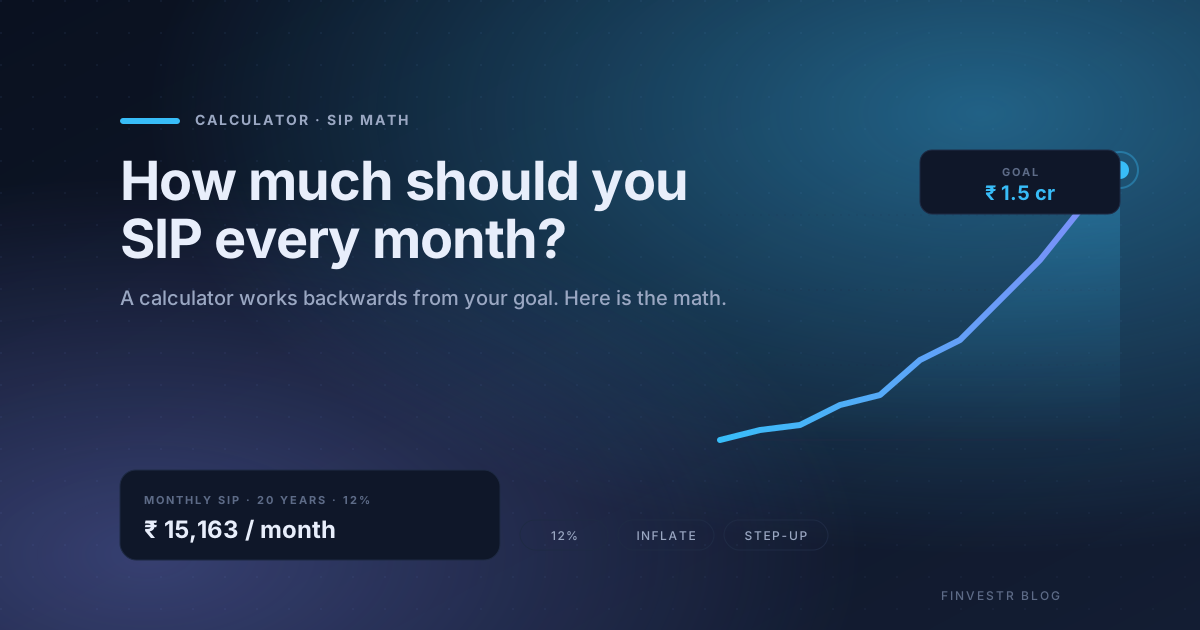
SIP calculator: how much to invest monthly for your goal
A SIP calculator works backwards from your goal. Here is the future-value math behind it, the realistic return and inflation assumptions for India, and how to size the monthly SIP for a retirement or education corpus.
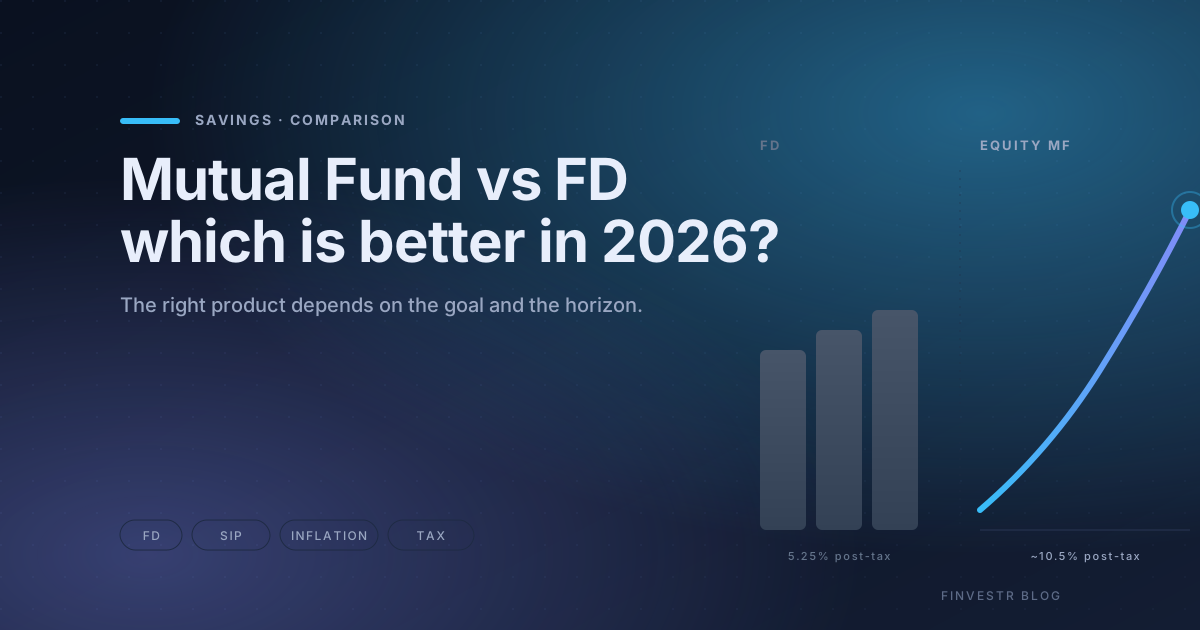
Mutual Fund vs FD: Which is better for you in 2026?
A side-by-side of FDs and equity mutual funds in 2026, with the after-tax return, the inflation-adjusted return, and the right answer for every goal from a 1-year emergency fund to a 15-year retirement SIP.
ELSS vs PPF: Which 80C option is better for you?
A plain-English comparison of the two most common 80C choices, with the lock-in, return, and risk trade-offs laid out side by side.