How much should your emergency fund be in India?
How many months of expenses belong in an emergency fund, where to park it (savings account, liquid fund, short-duration debt fund), and why the standard 3-6 months rule is wrong for most Indian households.
In this guide
- 1Compute your monthly essential expenses, not your salary. The emergency fund covers the bills you cannot stop paying when income drops to zero: rent or home loan EMI (Equated Monthly Instalment, the fixed monthly payment on a loan), groceries and utilities, school fees, insurance premiums, minimum credit card dues, and any EMIs you cannot defer. It does not cover discretionary spend (dining out, subscriptions, travel) and it does not cover savings (SIPs, retirement contributions).
- 2Pick the right number of months for your situation. The standard personal finance rule is 3-6 months of expenses, but the right number depends on your job stability, your household setup, and your existing buffers. Use the framework below to land on the right number for you.
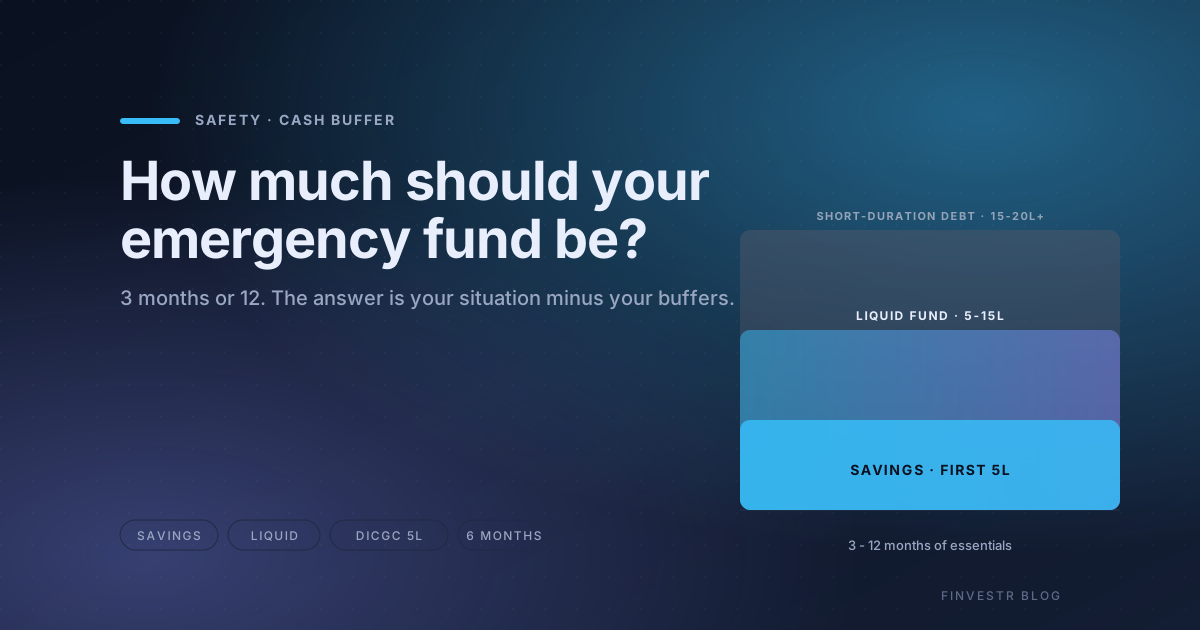
- 3Park the first ₹5 lakh in a high-interest savings account. The first ₹5 lakh of the emergency fund belongs in a savings account with a competitive interest rate (6-7% in 2026 from AU Small Finance Bank, Equitas, Ujjivan, Fi, Jupiter, etc.). Why a savings account: instant access, no exit penalty, no tax drag on interest in many cases (interest is tax-free up to ₹10,000/year for non-senior citizens under Section 80TTA), and the funds are immediately available without a 1-2 day redemption cycle. The first ₹5L is the 'break-glass-in-emergency' tier, the one you should never invest in anything with a 1-day settlement.
- 4Park the next ₹10-20 lakh in a liquid fund. The portion of the emergency fund above ₹5L (up to DICGC insurance of ₹5L per bank, which only covers FDs and savings, not mutual funds) belongs in a liquid mutual fund. Liquid funds invest in short-tenure government securities, bank CDs (Certificates of Deposit, short-term bank deposits), and commercial paper, with a portfolio duration of under 90 days. The NAV (Net Asset Value, the per-unit price of a fund) moves minimally, and redemption settles in T+1 (1 business day after you request the payout). The return in 2026 is roughly 6.5-7.5%, 0.5-1.5% above the best FD rate, with daily liquidity.
- 5Reassess the size every January and after every major life event. The emergency fund is not a one-time setup. It needs to grow with your essential expenses, which grow with inflation, EMIs, and family size. A 30-year-old with no kids and a small EMI in 2026 might have an essential monthly expense of ₹50,000 and a 3-month target of ₹1.5L. By age 35, with a kid and a home loan, the same household might have ₹1.2L of essentials and a 6-month target of ₹7.2L. The fund that was right at 30 is wrong at 35.
The '3-6 months of expenses' rule for emergency funds is the most-quoted and least-applicable piece of personal finance advice for Indian households. It was designed for two-income American households with stable jobs, liquid credit, and no extended family to support. Most Indian households are none of those things, and copying the rule produces emergency funds that are either too small (a 3-month target for a single-income household with a home loan) or too large (a 12-month target for a stable PSU employee with no dependents and a small EMI).
This post is the framework for sizing the emergency fund right for an Indian household in 2026, the right place to park it, and the reassessment cadence. The number you land on is the answer to the question 'how much cash do I need in the next 12 months if my income drops to zero tomorrow'. Not 3 months of expenses, not 6 months of expenses. Your situation, minus your buffers, minus your job security.
The first step: essential monthly expense, not gross
The biggest mistake in emergency fund sizing is using the wrong monthly expense number. Most calculators and templates ask for 'monthly expenses' and people plug in their gross monthly spend, including dining out, subscriptions, travel, and shopping. That is the wrong number.
The right number is the essential monthly expense: the bills that cannot stop when income stops. The list, in order of priority:
- Rent or home loan EMI (the largest single item for most urban households)
- Groceries and household supplies
- Utilities (electricity, water, gas, internet, mobile)
- Insurance premiums (health, term life, vehicle)
- School fees, tuition, child-related fixed expenses
- Minimum credit card dues (avoid late-payment penalties, but not the full balance)
- Other fixed EMIs (vehicle loan, personal loan, education loan)
- Medical subscriptions and regular medicines for any family member with a chronic condition
What is NOT essential:
- Dining out, entertainment, subscriptions
- Travel and vacations
- Shopping (clothes, gadgets, home improvement)
- SIPs and other savings contributions
- Discretionary investments (crypto, trading, F&O)
The essential monthly expense for a typical Indian household in 2026 is 60-75% of gross monthly spend, not 100%. To compute yours: pull the last 3 months of bank and credit card statements, classify each line item as essential or discretionary, sum only the essentials. The result is the monthly number you should multiply by your target months.
A worked example. A 35-year-old salaried employee in Bengaluru with a home loan EMI of ₹45,000/month and a child in school: - Home loan EMI: ₹45,000 - Groceries, utilities, household: ₹35,000 - Insurance premiums: ₹6,000 - School fees, child expenses: ₹25,000 - Vehicle EMI + fuel: ₹15,000 - Subscriptions, memberships: ₹4,000 - Discretionary (excluded): dining out ₹8,000, shopping ₹10,000, travel ₹15,000
Essential monthly expense: ₹1.30L. Gross monthly spend: ₹1.63L. The essential number is 80% of gross, which is on the high end (no extended family, no medical dependencies). At a 6-month target, the emergency fund should be ₹7.8L.
The framework: months by situation
The right number of months for the target depends on five factors: job stability, sector trend, household income structure, dependents, and recent job tenure. The framework below maps each combination to a number.
Job stability. Salaried employees with 10+ years of tenure and a track record of surviving sector downturns have low job-loss probability and short re-employment timelines. Salaried employees with 1-3 years of tenure or in industries with high churn (IT services, gig economy, startups) have higher job-loss probability and longer re-employment timelines. Add 1-2 months for every factor that increases risk.
Sector trend. Hiring or stable: banking, large FMCG, pharma, IT services in 2026 are net hirers, so the re-employment timeline is 1-3 months. Contracting: mid-tier IT, mid-tier startups, traditional media, real estate are contracting, so the re-employment timeline is 3-6 months. Add 1-3 months for contracting sectors.
Household income structure. Dual-income household with both partners earning: a job loss for one earner still leaves the other's income, so the household can absorb a 2-3 month gap. Single-income household with dependents: the gap is total, so the timeline should be the full re-employment cycle. Add 1-2 months for single-income households.
Dependents. No dependents (just the earner, no spouse/children/parents): 3 months minimum. Spouse only: 3-4 months. Children: 4-6 months. Children + parents: 6+ months. Add 1-2 months for each additional dependent set.
Recent job tenure. New job (under 12 months): add 1-2 months because the severance and notice period from the previous employer is not yet available. Established role (3+ years): standard.
The combined framework, by common situations:
- Stable salaried, dual-income, no kids, 3+ years tenure: 3 months
- Stable salaried, single-income, no kids, 3+ years tenure: 4-5 months
- Stable salaried, single-income, 1-2 kids, 3+ years tenure: 6 months
- Stable salaried, contracting sector, single-income, 1-2 kids: 6-8 months
- Freelancer or business owner, no dependents: 9 months
- Freelancer or business owner, with dependents: 12 months
- New job (under 12 months), single-income, 1-2 kids: 8-9 months
The framework is not 'pick a number in the 3-6 range'. It is 'your situation minus your buffers minus your job security'.
The parking spot: where the emergency fund actually sits
The standard advice is 'keep it in a savings account'. This is partially right: the first ₹5L should be in a high-interest savings account (6-7% in 2026 from AU Small Finance Bank, Equitas, Ujjivan, Fi, Jupiter). But parking ₹10-15L in a savings account earning 3.5% (the typical PSU or large private bank rate) is leaving real return on the table. The right structure for a typical ₹10-15L emergency fund:
- First ₹5L in a high-interest savings account at a different bank from your primary salary account. The 7% rate, the instant access, and the Section 80TTA tax break on the first ₹10,000 of interest make this the right tier for the break-glass money. The savings account is also psychologically separate from your daily spending money, which prevents accidental draws.
- Next ₹5-15L in a liquid mutual fund. Liquid funds invest in short-tenure government securities and bank CDs, with a portfolio duration under 90 days. The return in 2026 is 6.5-7.5%, slightly above the best FD rate, with T+1 (1 business day) redemption. The capital preservation is the same as an FD; the liquidity is similar (T+1 vs same-day for an FD).
- Anything above ₹15-20L in a short-duration debt fund or a sweep-in FD. The short-duration debt fund adds another 0.3-0.5% return with T+2 to T+3 redemption. The sweep-in FD keeps the funds at the same bank with same-day access but at a slightly lower rate.
The split has three purposes: instant access for the first ₹5L (true emergencies, no settlement cycle), nearly-instant access for the next tier (most emergencies, 1-day settlement), and slightly better return for the upper tier (the part of the emergency fund that is unlikely to be touched). The total emergency fund is in low-risk, high-liquidity vehicles, sized to the actual emergency scenarios, with the structure reflecting the probability of needing each tier.
What the emergency fund should NOT be
Three common mistakes that defeat the purpose of the emergency fund.
Equity mutual funds. The job of the emergency fund is to be there when you need it. Equity mutual funds can fall 30-40% in a bad year, and if your emergency coincides with a market crash (which is when most emergencies do, because the macro environment is worse for everyone), you will be forced to sell at a loss. Any money you might need in the next 3-5 years should not be in equity, full stop.
A single lump sum in a savings account at the primary bank. The lump sum at the primary bank gets drawn down for non-emergencies (vacations, gadgets, 'I will pay it back next month'). The psychologically separate account at a different bank, with a 1-day transfer friction, prevents accidental draws. The 0.5-1% premium on a high-interest small finance bank savings account is worth it.
Locked in FDs without sweep-in. A 1-year FD that auto-renews at maturity is not accessible in 24 hours without an exit penalty. The exit penalty on most 1-year FDs is 1% on the broken amount, which is 0.5-1% of the emergency fund per emergency use. The penalty is small but the friction is large, and the friction is the whole point. Sweep-in FDs or liquid funds solve this.
The reassessment cadence
The emergency fund is not a one-time setup. It needs to grow with your essential expenses, which grow with inflation, EMIs, and family size. The reassessment cadence:
- Once a year in January, alongside the SIP step-up. Recompute the essential monthly expense from the last 3 months of statements, recompute the right number of months from the framework above, top up the savings account or liquid fund to the new target. If the target has shrunk (e.g. paid off a home loan, child finished school), the surplus can move to a short-duration debt fund or to the next SIP step-up.
- Immediately after every life event that changes essential monthly expenses: a new home loan EMI, a child starting school, a parent's medical dependency, a spouse stopping work, a job change that affects notice period or severance. Each of these is a 1-3 month reassessment, not a January reassessment.
- When the liquid fund NAV changes by more than 1% in a single week. Liquid funds are not supposed to move, and a 1%+ move in a week suggests a credit event in the underlying portfolio. Review the fund's latest factsheet, and consider switching to a different liquid fund if the credit profile has changed.
The FinvestR-Agent runs the first two checks on every CAS upload. It classifies the user's bank accounts and liquid funds as 'emergency', computes the current emergency-fund coverage in months, and flags any coverage below 80% of the household's framework target.
The takeaway
The 3-6 months rule is wrong for most Indian households. The right emergency fund size is 3-12 months of essential expenses (not gross expenses), based on job stability, sector trend, household income structure, and dependents. The right parking spot is a high-interest savings account for the first ₹5L and a liquid mutual fund for the next ₹10-20L.
The cost of under-sizing is real: a job loss with no emergency fund means selling equity at a loss, taking on high-cost debt, or defaulting on EMIs. The cost of over-sizing is also real: too much in low-return liquid assets means the SIP step-up is smaller, the equity allocation is lower, and the long-run corpus is smaller. The framework in this post lands on the right number for your situation, not for an American two-income household.
If you want to see your emergency fund coverage, upload your CAS to the FinvestR-Agent. The agent computes the coverage from your bank and liquid-fund balances, sizes the target from your essential monthly expense and household profile, and flags any gap.
What to read next
- Mutual Fund vs FD in 2026 - the safety-sleeve math, with the FD vs liquid fund breakdown.
- How to start investing in mutual funds in India - the 10-minute flow for going from zero to your first SIP, with the emergency fund called out.
- How much you actually need to retire in India - the corpus math for the long-horizon goal the emergency fund is not for.
- XIRR vs CAGR vs Absolute Returns - the 3 numbers on your CAS, which one is honest.
- Best mutual funds to invest in India 2026 - the pillar shortlist, with the top liquid fund picks.
- NPS vs ELSS for retirement - the retirement math for the 80CCD(1B) deduction.
- The FinvestR living portfolio - what an actively managed, fully-transparent MF portfolio looks like in practice, including the emergency-fund alert.
- The monthly mutual fund rankings - the live top-10 in every category, refreshed monthly.
Frequently asked questions
How many months of expenses should be in an emergency fund?▾
The right answer depends on your situation, not on a rule of thumb. A stable salaried employee in a sector that is hiring needs 3 months. A salaried employee in a contracting sector or a single-income household needs 6 months. A freelancer or business owner needs 9-12 months. The wrong rule is the '3-6 months' blanket, which was designed for US households with 2-income stability and does not map to the single-earner Indian household with extended family. Use the framework in the post to land on the right number for your situation.
Should the emergency fund be in a savings account or a mutual fund?▾
Both. The first ₹5 lakh belongs in a high-interest savings account (6-7% in 2026, instant access, tax-free up to ₹10,000/year interest). The next ₹10-20 lakh belongs in a liquid mutual fund (6.5-7.5%, T+1 redemption, no exit load). The split is for two reasons: the savings account gives instant access without any settlement cycle, and the liquid fund gives slightly better return on the larger balance. Above ₹20-25 lakh, the excess can move to a short-duration debt fund or a sweep-in FD. The job of the emergency fund is capital preservation with liquidity, not return.
Where should I park an emergency fund above ₹5 lakh?▾
In a liquid mutual fund. The DICGC insurance (Deposit Insurance and Credit Guarantee Corporation, the body that insures bank deposits in India) covers up to ₹5 lakh per depositor per bank, and only covers deposits (FDs and savings), not mutual funds. Above ₹5L, the savings account and FD stop being insured, but a liquid fund's underlying portfolio is short-tenure government securities and bank CDs, which has its own safety profile. For a typical emergency fund of ₹5-15L, the split is ₹5L in a savings account + ₹5-10L in a liquid fund. For a larger emergency fund (single-income household with 6-9 month target), the liquid fund portion grows proportionally.
Is a sweep-in FD a good emergency fund vehicle?▾
Yes for part of it, with caveats. A sweep-in FD automatically moves excess savings balance into an FD, and automatically breaks the FD when you need funds. The rate is usually 1-1.5% below the headline FD rate, but the funds remain accessible. The catch: the FD is at the same bank as your primary account, so you do not get the psychological separation. And the rate is usually below what a high-interest savings account or liquid fund pays. A better structure: ₹5L in a high-interest savings account at a different bank, the rest in a liquid fund. Sweep-in FDs are useful as a third-tier (after savings and liquid) for the portion of the emergency fund above ₹15-20L.
Should I count my home loan EMI in the emergency fund calculation?▾
Yes, the home loan EMI is one of the largest essential monthly expenses for most Indian households, and it must be covered. The bank will not defer your EMI for a job loss. If your EMI is ₹40,000/month and the rest of your essential expenses (groceries, utilities, insurance, school) is ₹60,000/month, your essential monthly expense is ₹1L. At a 6-month target, the emergency fund should be ₹6L. The EMI is exactly the kind of fixed obligation that an emergency fund exists to cover, and skipping it in the calculation is the most common under-sizing mistake.
Does the emergency fund earn interest, and is it taxable?▾
Yes, it earns interest, and the tax treatment depends on the vehicle. Savings account interest is tax-free up to ₹10,000/year under Section 80TTA for non-senior citizens (₹50,000 for senior citizens under 80TTB). FD interest is fully taxable at slab rate, with 10% TDS above ₹40,000/year. Liquid fund gains (the difference between purchase NAV and redemption NAV) are taxed as per the post-April 2023 debt fund rules: gains are added to your income and taxed at slab rate, with no indexation. The after-tax return on a liquid fund is therefore similar to the post-tax return on a 1-year FD in the 30% slab, but with better liquidity. For most households, the savings account is the most tax-efficient vehicle for the first ₹5L.
What if my emergency fund is in equity mutual funds by mistake?▾
Move it. The job of an emergency fund is to be there when you need it, and equity mutual funds can fall 30-40% in a bad year. If your emergency coincides with a market crash, you will be forced to sell equity at a loss. The standard rule: any money you might need in the next 3-5 years should not be in equity, full stop. This includes the emergency fund. Move it to a savings account + liquid fund + short-duration debt fund split, sized to your essential monthly expense. The opportunity cost of holding ₹5-15L in low-return liquid assets is real but small compared to the cost of being forced to sell equity in a crash.
How often should I review my emergency fund?▾
Once a year in January, alongside the SIP step-up, plus immediately after every life event that changes essential monthly expenses: a new home loan, a child starting school, a parent's medical dependency, a spouse stopping work, a job change that affects notice period or severance. The review is two questions: what is my essential monthly expense today, and how many months of it should I hold? Recompute both, top up the savings account or liquid fund to the new target, and let the surplus move to a short-duration debt fund or the next SIP step-up. The FinvestR-Agent runs this check on every CAS upload and flags any emergency fund that has fallen below 80% of the household's target.
See your portfolio the way it should be seen.
Try the 1-min Goal CheckRelated reading
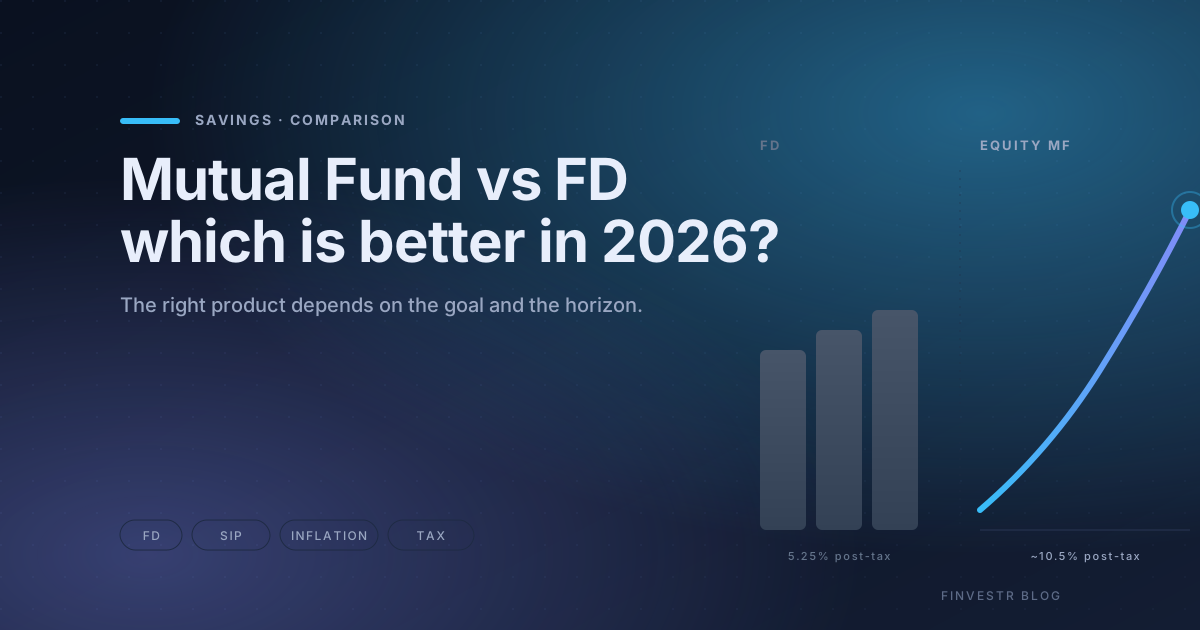
Mutual Fund vs FD: Which is better for you in 2026?
A side-by-side of FDs and equity mutual funds in 2026, with the after-tax return, the inflation-adjusted return, and the right answer for every goal from a 1-year emergency fund to a 15-year retirement SIP.
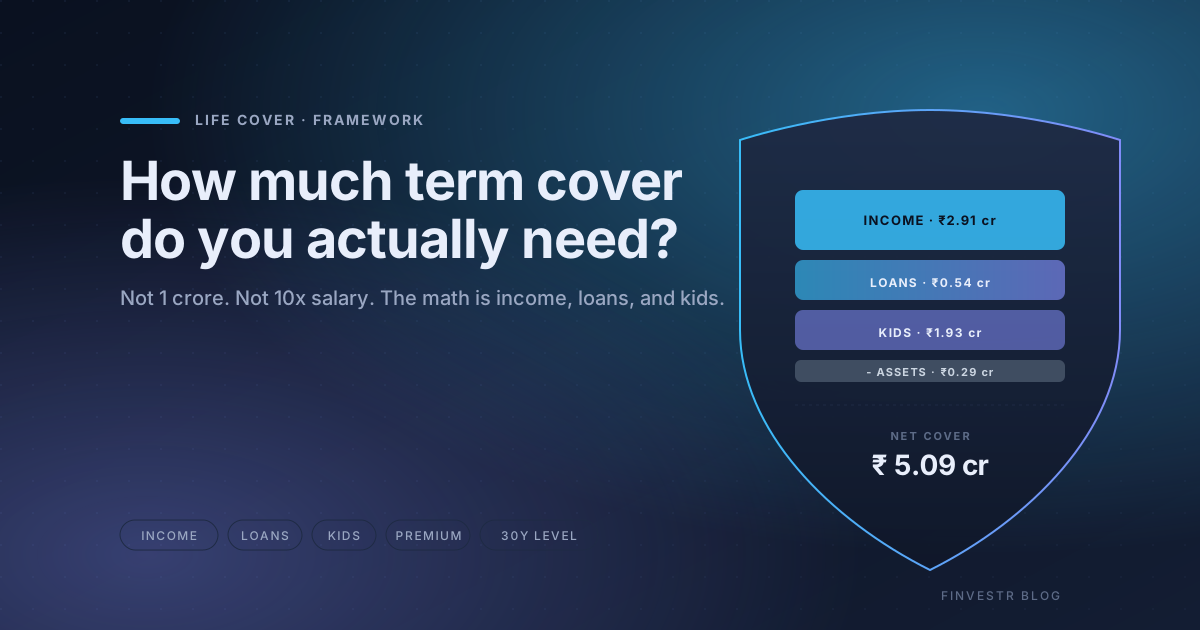
How much term insurance cover do you actually need in India?
A plain-English framework for sizing term insurance cover in India, the math behind income replacement and liability cover, the three multipliers to ignore, and how to log the policy in your net worth.
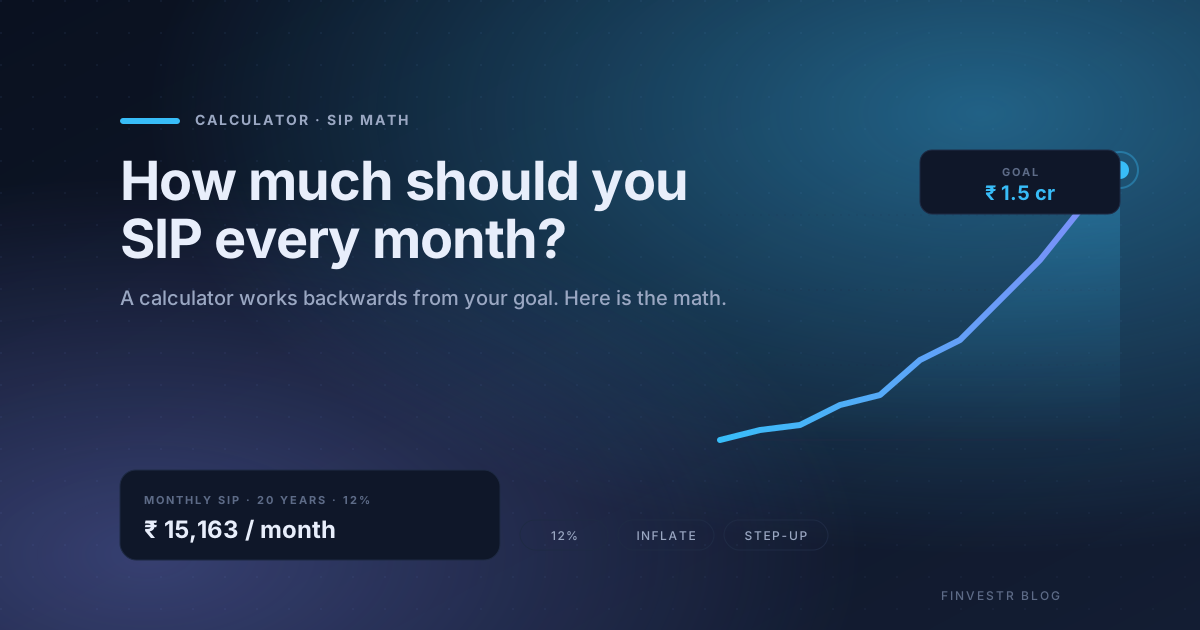
SIP calculator: how much to invest monthly for your goal
A SIP calculator works backwards from your goal. Here is the future-value math behind it, the realistic return and inflation assumptions for India, and how to size the monthly SIP for a retirement or education corpus.