How much term insurance cover do you actually need in India?
A plain-English framework for sizing term insurance cover in India, the math behind income replacement and liability cover, the three multipliers to ignore, and how to log the policy in your net worth.
In this guide
- 1Start with the Human Life Value, not a round number. The cover should be the present value of the income your family will lose if you are not around, plus the debts that fall on them, minus the assets they will inherit. The income-replacement number is the right anchor, not '1 crore' or '10x salary', which are two of the most-quoted and least-useful rules in Indian personal finance.
- 2Pick the years of income to replace. The income has to be replaced for the years until your family is financially independent. The right end date is not 'age 60' (the blanket rule) but the year your youngest child finishes education and your spouse's own income (if any) plus assets can sustain the household. Most households in 2026 land on 20-25 years of income replacement.
- 3Discount future income to today's value, because a rupee 25 years from now is not worth a rupee today. Use a real return (after inflation) of 4-5% per year. The discount factor for 25 years at 4% is 1 / 1.04^25 = 0.375. So ₹18L/year for 25 years discounted at 4% is ₹18L × 16.16 (the annuity factor) = ₹2.91 cr. This is the income-replacement component of the cover.
- 4Add outstanding liabilities that fall on the family. The cover has to clear any debt that the family would otherwise service from a smaller income: home loan outstanding, car loan outstanding, education loan, personal loan, credit card balance. The cover is the family's protection, not the individual's, and the debts that survive the insured are part of the protection. For a 35-year-old with a ₹45L home loan outstanding, ₹6L car loan, and ₹3L education loan, the liability component is ₹54L.
- 5Add the children's education and wedding corpus, if not already in the family plan. Many Indian families set aside ₹30-50L for each child's higher education and a similar amount for a wedding. If this corpus is not already in your mutual fund SIPs or FDs, it has to come from somewhere. For a household with 2 children and a ₹40L target per child for education plus a ₹25L target per child for wedding, the corpus component is ₹1.3 cr.
- 6Subtract existing assets that the family will inherit, but only the ones specifically earmarked. The total net worth is not the offset. The offset is the corpus that the family can actually use to bridge the income gap. EPF balance, PPF balance, FDs earmarked for emergencies, equity mutual fund value, real estate equity (if liquid). For a 35-year-old with ₹18L EPF, ₹4L PPF, ₹12L equity mutual fund, ₹80L home equity (₹1.2 cr home minus ₹40L outstanding), the offset is ₹1.14 cr (excluding the home equity, which is illiquid and not a quick bridge).
- 7Round to the nearest ₹50L, then buy a level-term plan. The cover should be a round number, but the round number comes from the math, not from a 1-crore or 10x-salary rule. For the worked example: ₹3.61 cr rounded to ₹3.5 cr or ₹4 cr. Buy a level-term plan (the cover stays constant through the term, not a decreasing-term plan, which assumes the loans pay down over time but does not account for inflation in expenses). Cover of ₹1 cr is for the lowest-income households; cover of ₹2-3 cr is for the typical salaried middle class; cover of ₹5 cr+ is for the high-income or business-owner segment.
Two rules of thumb show up in almost every article about term insurance in India. Buy 1 crore. Buy 10 times your annual income. Both are wrong for most households. Both produce covers that are either too small (the 1-crore rule for a 30-year-old earning ₹20L) or too round (the 10x rule ignores home loans, kids, and existing assets).
The honest answer comes from a four-component framework, with the math shown, and the answer is usually in the ₹2-5 crore range for a typical salaried middle-class family in 2026.
This post walks through that framework, the math behind each component, the three multipliers to ignore, and how to size the premium into a household budget. The framework is not a rule of thumb. It is a 7-step calculation, with the inputs you actually have (current income, outstanding loans, ages of children, existing assets) and an answer that lands on a round number after the math is done.
The framework, in one paragraph
The cover has four components, added together, minus the offset.
- Income replacement is the present value of the income your family will lose, discounted to today's value.
- Liability cover is the debts that fall on them on your death.
- Children corpus is the future education and wedding costs.
- The offset is the assets the family will inherit, applied conservatively.
The cover is the sum of the first three, minus the offset, rounded to the nearest ₹50L.
Step 1: Income replacement
The cover is anchored to the income you need replaced, not to a round number. The starting point is your current annual income from reliable sources:
- Salaried: gross salary minus perquisites that disappear on death (food coupons, phone reimbursements, LTA), plus the employer's contribution to EPF and gratuity.
- Business owner: average net profit of the last 3 years, with a 10-20% haircut for volatility.
- Freelancer: average of the last 3 years, with a 15-25% haircut for income lumpiness.
For a 35-year-old salaried employee earning ₹18L/year gross, the relevant income is roughly ₹16-17L after stripping the perquisites. For a 35-year-old business owner with average net profit of ₹24L/year, the relevant income is ₹20L after the volatility haircut.
The years to replace is the larger of:
- The years until your youngest child reaches age 22.
- The years until your own retirement.
A 35-year-old with a 4-year-old child and planned retirement at 60 has max(18, 25) = 25 years. A 35-year-old with a 14-year-old and the same retirement has max(8, 25) = 25 years (the income still has to be replaced through the child's education years, but the replacement can come from a partial drawdown of the corpus).
The math. A 35-year-old earning ₹18L/year with 25 years of income to replace, discounted at 4% real return, produces an income-replacement component of ₹2.91 cr.
The annuity factor at 4% for 25 years is 15.62 (annuity-due basis 16.16). Annual income × annuity factor = ₹18L × 16.16 = ₹2.91 cr. The same calculation at ₹30L annual income gives ₹4.85 cr, and at ₹60L gives ₹9.70 cr. The component scales linearly with income and with the years to retirement.
The discount rate of 4% real is the conservative anchor. A higher real return (5-6%) is plausible for an equity-heavy portfolio, but the term-plan payout is typically invested in a balanced or debt portfolio, not in equity. 4% real is the realistic number.
Step 2: Liability cover
The cover has to clear the debts that the family would otherwise service from a smaller income. The relevant debts:
- Home loan outstanding (the largest line item for most urban households)
- Car loan outstanding
- Education loan
- Personal loan
- Credit card balance
For a 35-year-old with a ₹45L home loan, ₹6L car loan, and ₹3L education loan, the liability component is ₹54L.
The relevant balance is the principal outstanding, not the original loan amount (which is what was borrowed years ago, not what is owed today). Pull the latest statement from each lender; the numbers should match your annual credit report.
The home loan is the largest line item for most urban households. The EMI continues for 15-25 years after the original disbursement, and the family would need to service the EMI from a smaller income if the primary earner is not around. The cover for the home loan is the full principal outstanding, not a fraction of it.
Step 3: Children corpus
The corpus for higher education and weddings is a separate line item, with its own growth rate. Education costs in India have grown at 8-10% p.a. for the last decade, well above general inflation.
A 4-year-old's undergraduate engineering in 18 years at 8% inflation: ₹25L today becomes ₹1.0 cr. A 4-year-old's wedding in 22 years at 6% inflation: ₹25L today becomes ₹93L. Two kids: ₹3.86 cr in 18-22 years.
The corpus is added to the cover, not subtracted from the income-replacement component. The reason: the corpus is a discrete obligation, due at specific dates, and the income-replacement component is a flow that has to be maintained for 25 years. Adding the two gives a cover that covers both.
If the corpus is already in your mutual fund SIPs, FDs, or PPF, the corpus component shrinks. The framework assumes the corpus is not yet built. A household that has been SIP-ing ₹40,000/month into a child-fund portfolio for 5 years may have ₹40L already, which reduces the corpus component by that amount.
Step 4: The offset (conservatively applied)
The total net worth is not the offset. The offset is the corpus that the family can actually use to bridge the income gap, applied with haircuts for liquidity and vesting risk.
| Asset | Offset % | Why |
|---|---|---|
| EPF balance | 100% | Vested, accessible, predictable |
| PPF balance | 100% | Vested, accessible, predictable |
| FD balance | 100% | Liquid at maturity, predictable |
| Equity mutual fund | 90% | Mark-to-market risk, small haircut |
| Gold | 80% | Liquidity haircut |
| Real estate equity | 0% | Illiquid, fire-sale risk |
| Stock options / RSUs | 50% of vested | Vesting risk, liquidity risk |
| Business equity | 0% | Illiquid, may be the source of income being replaced |
For a 35-year-old with ₹18L EPF, ₹4L PPF, ₹12L equity mutual fund, and no gold, the offset is ₹28.8L (EPF + PPF + 90% of equity). The home equity (₹1.2 cr home value minus ₹45L outstanding = ₹75L) is excluded as illiquid.
Step 5: The net cover
The four components, added, minus the offset, gives the net cover. For the worked example:
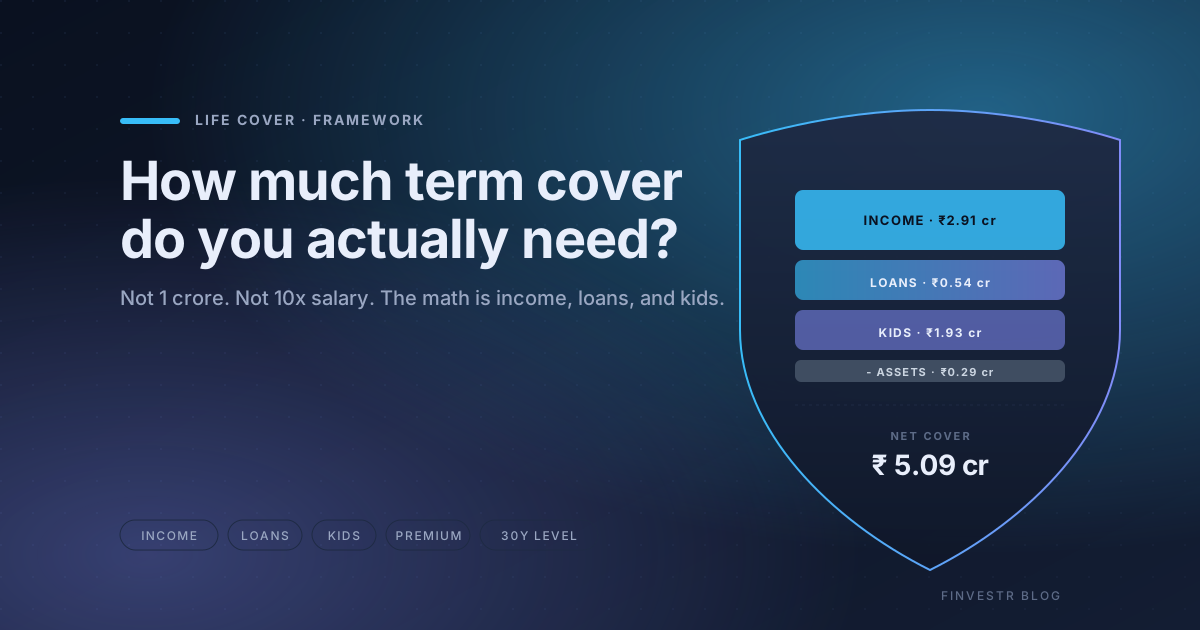
- Income replacement: ₹18L × 16.16 = ₹2.91 cr
- Liabilities: ₹45L + ₹6L + ₹3L = ₹54L
- Children corpus: ₹1.0 cr + ₹93L = ₹1.93 cr
- Offset: ₹28.8L
Net cover: ₹2.91 + ₹0.54 + ₹1.93 - ₹0.29 = ₹5.09 cr. Rounded to the nearest ₹50L: ₹5 cr.
The same calculation at ₹30L annual income: ₹4.85 + ₹0.54 + ₹1.93 - ₹0.29 = ₹7.03 cr, rounded to ₹7 cr. At ₹60L: ₹9.70 + ₹0.54 + ₹1.93 - ₹0.29 = ₹11.88 cr, rounded to ₹12 cr.
The 1-crore rule is half of what a typical ₹18L-income household needs. The 10x rule (₹1.8 cr for the same household) is a third. The framework produces 25-30x for the typical case, which is the math the round numbers are hiding.
Use the FinvestR income replacement calculator to size this component from your own salary and years to retirement. The same calculator powers the what-if flow for the FinvestR-Agent: the chat can run a target-cover calculation against your logged income and family profile in one line.
Step 6: Level-term vs decreasing-term
A level-term plan keeps the cover constant through the term. A decreasing-term plan reduces the cover over time, typically in line with a home loan amortization schedule.
- Level-term is right for income replacement and education corpus, because the obligations do not shrink.
- Decreasing-term is right for a pure home-loan-clearing cover, because the loan balance shrinks.
The simpler default: a single level-term plan for the full cover. The premium is comparable to a decreasing-term plan for the same starting cover, and the flexibility is higher. The decreasing-term plan is for the case where the only objective is to clear a home loan on death and the income-replacement component is already covered separately.
Step 7: Premium and budget
The premium per lakh of cover for a healthy 30-year-old non-smoker is roughly ₹80-100/year for a 30-year level-term plan from HDFC Life, ICICI Pru, Tata AIA, or Max Life.
- At age 30: ₹80-100/lakh → ₹1 cr cover costs ₹8,000-10,000/year
- At age 35: ₹110-130/lakh → ₹1 cr cover costs ₹11,000-13,000/year
- At age 40: ₹160-200/lakh → ₹1 cr cover costs ₹16,000-20,000/year
- Smokers pay 1.5-2x the non-smoker rate
For the worked example: ₹5 cr cover, 30-year-old, 30-year level-term, non-smoker, premium roughly ₹40,000-50,000/year. For the same cover at 35: ₹55,000-65,000/year. The premium is the cost of the protection. The alternative is no protection, which is the cost of the family losing 70-80% of its annual income in a single event.
The premium should be sized as a fixed line in the monthly budget, not as a discretionary outflow. The right anchor: 0.3-0.5% of annual income for a healthy 30-year-old, 0.5-0.8% for a healthy 35-year-old. The cost is real, but the absence of the cover is more expensive.
Use the FinvestR premium calculator to see the actual premium for your age, cover, and term across the four main insurers. The calculator pulls the latest premium rates from each insurer's published grid.
The three multipliers to ignore
Three rules of thumb show up in almost every term-insurance article, and all three are wrong.
1 crore
The round number is appealing because it is easy to remember and easy to communicate. It is also roughly half of what the framework produces for the typical ₹18-30L-income household. The 1-crore rule was correct in 2005 when ₹1 cr was 50x per-capita income. In 2026, it is closer to 10x per-capita income, and the obligations (education, weddings, healthcare) have grown faster than the cover.
10x annual income
A rough shortcut that works for a 35-year-old with 25 years to retirement at a 4% real return, but ignores home loans, education corpus, and existing assets. The framework produces 20-30x for households with kids and loans, and 15x for households without. The 10x rule is a floor, not a target.
Until age 60
The blanket end date ignores the years-to-independence calculation. A 35-year-old with a 4-year-old child needs the cover until 2043 (when the child turns 22), which is 17 years from now, not 25. A 35-year-old with a 14-year-old needs the cover until 2032, which is 6 years from now. The end date is the larger of (i) the years to the child's independence and (ii) the years to retirement, capped at 30 years.
The reassessment cadence
The cover is not a one-time calculation. It needs to grow with income, with liabilities, and with family changes, and it shrinks as assets accumulate. The reassessment cadence:
- Once a year in January, alongside the SIP step-up. Recompute the income-replacement component (income has likely grown), the liability component (loans have likely paid down), the corpus component (kids are closer to college age), and the offset (assets have grown). The net cover moves in both directions.
- After every major life event: a new home loan, a child starting school, a parent's medical dependency, a salary jump of 30%+. Each is a 1-3 month reassessment, not a January reassessment.
- At age 45: the cover can usually be reduced. The children are likely through college, the home loan is closer to paid off, the corpus is partially built. The right cover at 45 is often 40-60% of what it was at 35, with the same term or shorter.
The FinvestR-Agent runs the first two checks on every CAS upload and on every insurance entry added to the chat. The agent computes the current cover from the policies logged, sizes the framework target from the household profile, and flags any gap.
How to log the policy in your net worth
The policy itself is not an asset in the conventional sense (it has no surrender value, and the payout is contingent on death), but it is a contingent asset in the net-worth view, and the annual premium is a real outflow. The chat accepts plain-English statements and adds the policy to the insurance tab.
> You: "I have a 1Cr term plan with HDFC Life, premium 12k a year"
> Agent: "Got it. Noted: HDFC Life term plan, sum assured ₹1,00,00,000, premium ₹12,000/year. When does the policy mature?"
> You: "2034"
> Agent: "Updated. The cover now shows in your net worth view as a contingent asset, and the premium is captured in your annual outflows."
The agent will not recommend how much cover you need (that is regulated advice), but it will log what you have bought and surface the gap against the framework target computed from your income, loans, and family profile. The full chat walkthrough is in Just tell the chat.
The takeaway
The 1-crore and 10x-salary rules are wrong for most Indian households in 2026. The right cover is the sum of the income-replacement component (annual income × annuity factor for the years to independence), the liability component (outstanding loans), and the children-corpus component (inflated education and wedding costs), minus the offset (existing assets applied with liquidity haircuts).
For a typical 35-year-old earning ₹18-30L with a home loan and 2 children, the framework produces a cover of ₹4-7 cr, not 1-3 cr.
The premium for a healthy 30-35 year old, 30-year level-term plan is ₹80-130 per lakh of cover, which is ₹40,000-90,000/year for ₹5 cr of cover. The cost is 0.3-0.8% of annual income, a fixed line in the budget. The absence of the cover is the cost of the family losing 70-80% of its income in a single event, plus the obligation to clear the home loan and fund the children's education from a smaller base.
Use the FinvestR term cover calculator to size the cover for your own income, loans, and family profile. The same flow runs inside the FinvestR-Agent: the agent walks through the 7 steps, asks only for the inputs it does not have, and lands on a recommended cover in one minute.
What to read next
- Just tell the chat - the full walkthrough for logging term insurance, FDs, loans, and other assets in plain English via the FinvestR-Agent.
- How to start investing in mutual funds in India - the 10-minute flow for going from zero to your first SIP, with the emergency fund and the term plan called out as the first two steps.
- How much you actually need to retire in India - the corpus math for the long-horizon goal the term plan bridges to.
- How much should your emergency fund be in India - the cash buffer that sits behind the term plan, sized to your situation.
- Mutual Fund vs FD in 2026 - the safety-sleeve math, with the FD vs liquid fund breakdown.
- The FinvestR living portfolio - what an actively managed, fully-transparent MF portfolio looks like in practice, with the term plan, emergency fund, and SIPs all visible.
- The monthly mutual fund rankings - the live top-10 in every category, refreshed monthly.
Frequently asked questions
Is 1 crore term cover enough for a middle-class Indian family?▾
Usually not. 1 crore at 4% real return produces ₹4L/year of safe income, which covers the essentials of a single-income household earning up to ₹10L/year. For a household earning ₹20-30L/year with a home loan, a child in school, and a spouse without independent income, 1 crore is roughly half of what the framework produces. The honest answer depends on the math, not the round number. The post walks through the framework and the worked example.
Is the '10x annual income' rule of thumb correct?▾
It is a rough shortcut, not a framework. 10x annual income works for a 35-year-old with 25 years to retirement at a 4% real return, but it ignores home loan liabilities, education corpus, and existing assets. A 35-year-old earning ₹30L with a ₹80L home loan outstanding, 2 children in school, and ₹50L in mutual funds needs cover of 30L × 16.16 + 80L + 1.3 cr - 50L = ₹6.35 cr, not 10x30L = ₹3 cr. The math produces a 20x number for households with kids and loans. Use the framework, not the multiplier.
What is the difference between a level-term and a decreasing-term plan?▾
A level-term plan keeps the cover constant through the term: a 30-year, ₹1 cr plan pays ₹1 cr whether the insured dies in year 1 or year 30. A decreasing-term plan reduces the cover over time, typically in line with a home loan amortization schedule. The level-term plan is right for income replacement and education corpus. The decreasing-term plan is right for a home loan where the family wants the debt cleared on death. Most Indian families need both, so a level-term plan for the bulk and a smaller decreasing-term plan for the home loan is one approach, or a single level-term plan that covers both is the simpler default.
Should I buy term insurance online or through an agent?▾
Online, directly from the insurer's website or from a comparison site. The premium is 10-25% lower than the agent-sold price because the agent commission (15-35% of the first-year premium) is removed. The claims process is identical. The medical exam (if required) is scheduled at home. The policy is issued the same day for non-medical cases. The only reason to use an agent is if you need help comparing riders or you have a pre-existing condition that needs underwriter review. For the standard 30-year-old, ₹1 cr, 30-year level-term case, online is the default.
What is the right cover for a 30-year-old with no kids and no home loan?▾
The framework produces a cover of roughly 15x annual income for this case. A 30-year-old earning ₹15L/year with 25 years to retirement, no home loan, no kids, and ₹8L in mutual funds needs cover of 15L × 15.62 (annuity factor at 4% for 25 years) - 8L = ₹2.26 cr. Round to ₹2 cr. Premium for a 30-year, ₹2 cr level-term plan for a healthy 30-year-old: roughly ₹16,000-20,000/year. The cover falls as the family situation changes (kids, loans, assets), which is why the post recommends a January reassessment.
Is LIC the right insurer for term insurance in 2026?▾
LIC is one of several. The claim settlement ratio (CSR) is the most important number: the percentage of claims paid out of total claims filed. LIC's CSR has ranged 98-99% in recent years, which is good but not the highest. HDFC Life, ICICI Pru, Tata AIA, Max Life, and Bajaj Allianz have CSRs in the 99-99.5% range. The premium is comparable across these insurers for a healthy non-smoker. The right way to pick: compare 3-4 quotes online for your specific age and cover, look at the CSR for the last 3 years, and check the solvency ratio (the insurer's ability to pay claims, should be above 1.5). The brand name matters less than the CSR and solvency.
Should I buy a return-of-premium term plan?▾
No, in most cases. A return-of-premium (ROP) term plan returns the total premiums paid if the insured survives the term, but the premium is 2-3x the level-term premium. The math: a 30-year, ₹1 cr level-term plan costs roughly ₹10,000/year (₹3L total over 30 years). The ROP version costs ₹25,000-30,000/year (₹7.5-9L over 30 years). If you invest the ₹15-20K/year difference in an index fund at 12% for 30 years, you get roughly ₹3.5-5 cr at the end. The ROP returns your premiums, the index fund returns 5x your premiums. The ROP is for the investor who would otherwise spend the difference, which is not the audience of this blog.
How do I log my term plan in my net worth?▾
Tell the FinvestR-Agent. The chat accepts plain-English statements like 'I have a 1Cr term plan with HDFC Life, premium 12k a year' and adds the policy to the insurance tab. The sum assured shows up in the net worth view as a contingent asset, separately from the premium outflow. The maturity date, premium frequency, and policy number are optional and can be added later. The agent confirms the addition in one sentence and updates the dashboard. The agent refuses to recommend how much cover you need (regulated advice) but happily logs what you have bought.
See your portfolio the way it should be seen.
Try the 1-min Goal CheckRelated reading

How much should your emergency fund be in India?
How many months of expenses belong in an emergency fund, where to park it (savings account, liquid fund, short-duration debt fund), and why the standard 3-6 months rule is wrong for most Indian households.

Just tell the chat: how FinvestR-Agent keeps track of your FDs, loans, and insurance
Your MFs are already in the agent. The FDs, PPF, EPF, home loan, credit card, and term cover are not. The fix is one chat sentence at a time. Here is what the chat understands and what it won't do.

SIP calculator: how much to invest monthly for your goal
A SIP calculator works backwards from your goal. Here is the future-value math behind it, the realistic return and inflation assumptions for India, and how to size the monthly SIP for a retirement or education corpus.