SIP calculator: how much to invest monthly for your goal
A SIP calculator works backwards from your goal. Here is the future-value math behind it, the realistic return and inflation assumptions for India, and how to size the monthly SIP for a retirement or education corpus.
In this guide
- 1Decide the goal amount in today's rupees, then inflate it to the year you need it. The SIP calculator compounds your money forward, but expenses inflate forward too. So the first input is not the amount you need today, it is the amount you will need in the target year, grown at inflation.
- 2Pick a realistic rate of return for the SIP. This is the assumption that moves the number the most. For an equity mutual fund SIP over 10+ years, 12% is a reasonable planning number, but not a guarantee. For a shorter horizon or a lower-risk portfolio, use 8-10%. The calculator is only as honest as this input.
- 3Run the future-value formula to find the monthly SIP. The future value of a monthly SIP is: FV = P × [((1 + i)^n − 1) / i] × (1 + i), where P is the monthly SIP, i is the monthly rate (annual return ÷ 12), and n is the number of months. Solve this for P given your inflated goal FV.
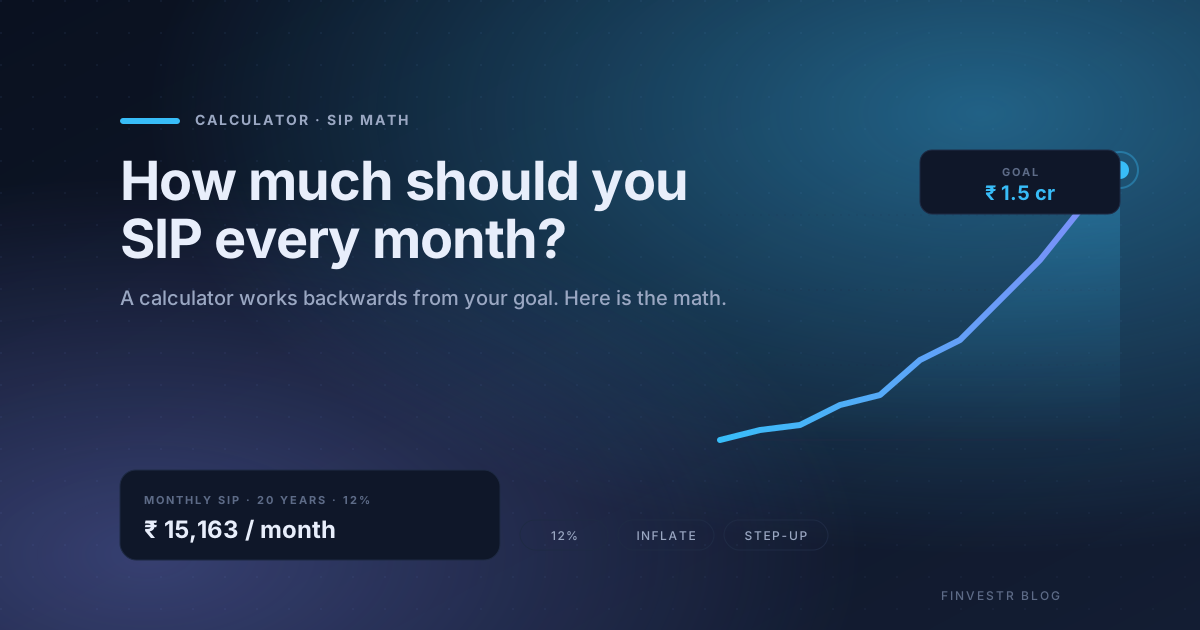
- 4Work an example. To reach ₹1.5 cr in 20 years at 12% annual return: the monthly rate is 1%, the annuity factor over 240 months is 989.26, and the monthly SIP is ₹1,50,00,000 ÷ 989.26 = ₹15,163. That is the number the calculator returns.
- 5Use a step-up SIP to keep the real effort constant. A fixed SIP of ₹15,163 today feels easy now and harder later as your expenses inflate. A step-up SIP raises the monthly amount by a fixed percentage each year (say 10%), so the real burden stays roughly flat and the final corpus grows faster.
- 6Subtract what you already have, then review every January. If you already hold a lumpsum or a running SIP toward the goal, the gap you need to fill is smaller. Recompute the SIP on the remaining gap, not the full goal. And because both inflation and your corpus change every year, re-run the calculation once a year.
Most people open a SIP calculator and type in a monthly amount, a return, and a number of years, and watch the corpus grow. That is the forward direction, and it is mildly fun. But the question people actually ask is the reverse one: how much do I need to invest every month to reach my goal?
The reverse direction is the honest way to use a SIP calculator. You decide the goal, you inflate it to the year you need it, you pick a realistic return, and the calculator tells you the monthly SIP. This post is the math behind that reverse calculation, with the worked examples for retirement and a child's education, and the return assumptions that are realistic for India.
The one input most people get wrong: the goal amount
The first input to a reverse SIP is not the amount you need today, it is the amount you will need in the target year, grown at inflation. This is where most under-sizing happens.
The inflation rate depends on the goal:
- Retirement: your post-retirement monthly expense, inflated at 6% per year (general inflation).
- Child's higher education: today's cost, inflated at 8% per year (education inflation in India has run 8-10% for a decade).
The inflation math. A ₹30,000 monthly expense today, retired in 20 years at 6% inflation, becomes ₹30,000 × 1.06^20 = ₹96,214/month. A ₹25L engineering degree today, needed in 15 years at 8%, becomes ₹25,00,000 × 1.08^15 = ₹79.3L. If you skip the inflation step, every downstream number is too small.
The second input: a realistic return
The return assumption moves the monthly SIP more than any other input. The honest planning numbers for India:
- 10+ year equity SIP: assume 12% per year (the long-run Nifty 50 return before inflation).
- 5-7 year horizon, or a lower-risk portfolio: assume 8-10%.
- Do not use 15-18% just because a fund had a good year. That is the outlier, not the plan.
The calculator is only as honest as this number. Feed it a fantasy return and it returns a fantasy SIP.
The formula behind every SIP calculator
The future value of a monthly SIP is:
> FV = P × [((1 + i)^n − 1) / i] × (1 + i)
Where:
- P = monthly SIP amount
- i = monthly return rate (annual return ÷ 12)
- n = number of months
The trailing (1 + i) converts end-of-month payments to start-of-month, which is the standard SIP assumption.
To find the SIP that reaches a target corpus, solve for P:
> P = goal ÷ {[((1 + i)^n − 1) / i] × (1 + i)}
This is exactly what a SIP calculator does internally. The FinvestR SIP calculator runs the same formula and shows you both the forward and reverse numbers.
Worked example: ₹1.5 cr in 20 years
Let me walk through the full math. Goal: ₹1.5 cr in 20 years at 12% annual return.
1. Monthly rate: 12% ÷ 12 = 1% per month (i = 0.01).
2. Months: 20 × 12 = 240.
3. Annuity factor: [((1.01)^240 − 1) / 0.01] × 1.01 = 989.26.
4. Monthly SIP: ₹1,50,00,000 ÷ 989.26 = ₹15,163/month.
The same goal, different horizons:
| Goal | Horizon | Return | Monthly SIP |
|---|---|---|---|
| ₹1.5 cr | 20 years | 12% | ₹15,163 |
| ₹1.5 cr | 25 years | 12% | ₹9,020 |
| ₹1 cr | 20 years | 12% | ₹10,109 |
| ₹1 cr | 25 years | 12% | ₹6,013 |
| ₹1.5 cr | 15 years | 12% | ₹26,100 |
The pattern is the whole point of starting early: pushing the goal from 20 to 25 years cuts the monthly SIP by 40%, because the extra five years give compounding far more room. The earlier you start, the smaller the number that has to leave your pocket every month.
Worked example: a child's education
For a child's engineering degree needed in 15 years, today's cost ₹25L, at 8% education inflation:
1. Inflated goal: ₹25,00,000 × 1.08^15 = ₹79.3L.
2. Monthly rate: 12% ÷ 12 = 1%.
3. Months: 15 × 12 = 180.
4. Annuity factor: [((1.01)^180 − 1) / 0.01] × 1.01 = 501.01.
5. Monthly SIP: ₹79,30,000 ÷ 501.01 = ₹15,828/month.
If you start 5 years earlier (20 years to the goal), the inflated target becomes ₹25L × 1.08^20 = ₹1.17 cr, but the annuity factor over 240 months is 989.26, giving a monthly SIP of ₹11,805. Starting earlier both grows the target (more inflation) and cuts the SIP (more compounding); for education, starting early wins on the SIP side.
Subtract what you already have
If you already hold a lumpsum or a running SIP toward the goal, the gap is smaller than the full goal. Recompute the SIP on the remaining gap, not the full amount.
The offset. You already have ₹20L toward the ₹1.5 cr retirement goal. The remaining gap is ₹1.5 cr − ₹20L = ₹1.3 cr. The monthly SIP for ₹1.3 cr over 20 years at 12% is ₹1,30,00,000 ÷ 989.26 = ₹13,141, instead of ₹15,163. Every rupee of existing corpus you grow toward the goal lowers the monthly burden.
A step-up SIP keeps the effort flat
A fixed SIP of ₹15,163 feels easy today and harder in 10 years as your expenses inflate. A step-up SIP raises the monthly amount by a fixed percentage each year (commonly 10%), so the real burden stays roughly flat and the final corpus grows faster.
The trade-off is discipline. The step-up only works if you actually raise the amount every January. If you will not, a flat SIP you stick with beats a step-up you abandon. The FinvestR Goal Check runs both paths and shows the difference in your numbers.
Review every January
Both inflation and your corpus change every year, so the correct SIP changes too. The annual review:
- Re-inflate the goal to the new target year.
- Re-check the return assumption against the current market.
- Re-add your existing corpus for the growth it earned.
The FinvestR-Agent does this on every CAS upload: it recomputes the gap between your logged goals and your current corpus, sizes the remaining monthly SIP, and flags any shortfall in plain English.
The bottom line
A SIP calculator works backwards from your goal. You inflate the goal to the year you need it, pick a realistic return (12% for a long equity SIP, 8-10% for shorter), and the future-value formula tells you the monthly SIP. The earlier you start, the smaller the number, because compounding does the heavy lifting.
For a ₹1.5 cr goal, the monthly SIP is ₹15,163 over 20 years or ₹9,020 over 25 years at 12%. Starting 5 years earlier cuts the monthly burden by 40%. Subtract what you already have, use a step-up if you can commit to it, and re-run the numbers every January.
Run the FinvestR SIP calculator with your own goal, horizon, and return to get the number for your situation. Then open the 1-min Goal Check to have the agent recompute the gap against your actual holdings and step-up path.
What to read next
- How much you actually need to retire in India - the corpus math this SIP feeds into.
- XIRR vs CAGR vs Absolute Returns - the honest number for the SIP you are running, and why it is not the same as the headline return.
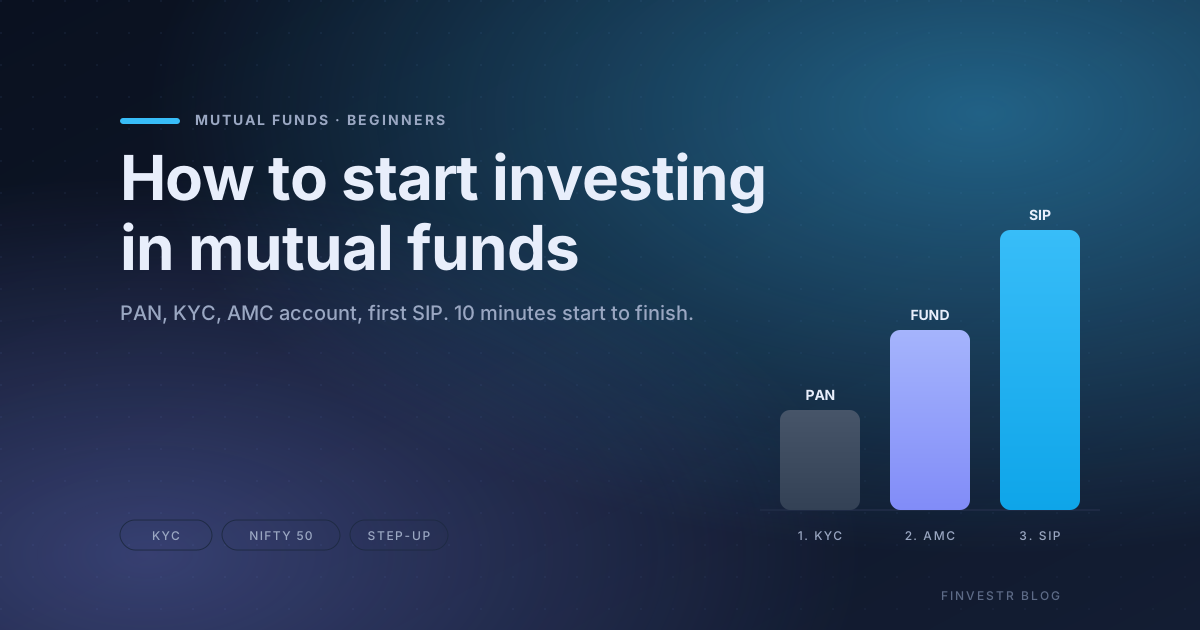
- How to start investing in mutual funds in India - the 10-minute flow for setting up your first SIP.
- The monthly mutual fund rankings - the current top funds in every category, for the SIP's underlying allocation.
Frequently asked questions
How does a SIP calculator work?▾
It applies the future-value formula for a series of monthly payments. Given your monthly SIP, annual return, and number of years, it compounds every instalment forward and sums the result. Working backwards, it solves for the monthly SIP that reaches a target corpus. The formula is FV = P × [((1 + i)^n − 1) / i] × (1 + i), where P is the monthly amount, i is the monthly return rate, and n is the number of months.
What return should I assume for an SIP calculator?▾
For a 10+ year equity mutual fund SIP, assume 12% per year. For a 5-7 year horizon or a lower-risk portfolio, assume 8-10%. Do not use 15-18% just because a fund had a strong year. The long-run Nifty 50 return before inflation is around 12%, and that is the honest planning number. The calculator is only as accurate as the return you feed it.
What is the SIP amount for ₹1 crore in 20 years?▾
At a 12% annual return, ₹1 cr in 20 years needs a monthly SIP of roughly ₹10,109. Over 25 years it drops to about ₹6,013, and over 15 years it rises to about ₹17,400. The exact number depends on the return assumption and how many years you give compounding, which is why you should run your own numbers in the calculator.
Does a higher NAV mean I need a higher SIP?▾
No. The SIP buys units at whatever the NAV is on each instalment date, but the number of units you buy is not what determines your goal. What matters is the percentage growth of the fund over your holding period. A ₹20 NAV fund and a ₹200 NAV fund with the same returns need the same SIP to reach the same goal. NAV level is irrelevant to SIP sizing.
What is a step-up SIP and should I use one?▾
A step-up SIP raises your monthly amount by a fixed percentage every year (commonly 10%). It keeps the real effort roughly constant as your income and expenses grow, and it reaches a larger final corpus than a fixed SIP. It is worth using if you can commit to actually increasing the amount annually. If you will not, a flat SIP you stick with beats a step-up you abandon.
Should I use 12% for a SIP shorter than 5 years?▾
No. Over 5 years or fewer, equity returns are volatile and can easily be negative on a calendar-year basis. Use 8-10% for a 3-5 year horizon, and reconsider whether equity is even the right vehicle for a sub-3-year goal. The emergency fund and short-term money belong in liquid or short-duration debt funds, not a long-horizon equity SIP.
How does inflation affect the SIP amount?▾
Inflation raises the future cost of your goal, which raises the SIP needed to reach it. A ₹30,000 monthly retirement expense today becomes ₹96,000 in 20 years at 6% inflation, so the corpus must cover the inflated number, not the current one. If you ignore inflation, you will under-size the SIP and come up short. Always inflate the goal amount first, then run the SIP math on the inflated number.
What is a good XIRR assumption for SIP planning?▾
XIRR is the actual annualised return of your SIP, accounting for the timing of every instalment. For planning, assume a portfolio XIRR of 11-13% over a 10+ year equity SIP. A higher assumed XIRR lowers the monthly SIP but is less honest. Use the assumption that survives a bad decade, not the one that flatters the number.
See your portfolio the way it should be seen.
Try the 1-min Goal CheckRelated reading

How much do you actually need to retire in India?
A practical breakdown of the math behind a retirement corpus, from expenses to inflation to the SIP that gets you there.
How to start investing in mutual funds in India (2026)
Everything you need to go from zero to your first SIP: KYC, PAN, picking an AMC, choosing a fund, automating the SIP, and the three funds most beginners actually need to start with.
NPS vs ELSS for retirement: which one actually wins?
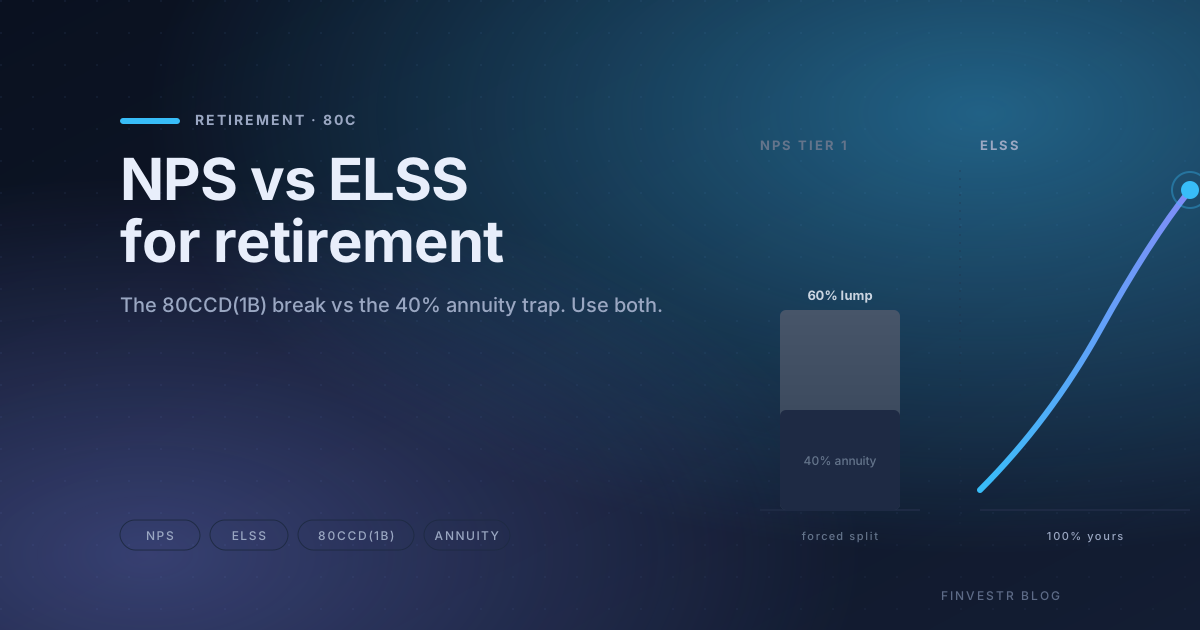
A side-by-side of NPS Tier 1 and ELSS for retirement: tax breaks, lock-in, returns, the NPS annuity trap, and the right answer for different retirement horizons.