SWP: how much can you withdraw monthly from mutual funds?
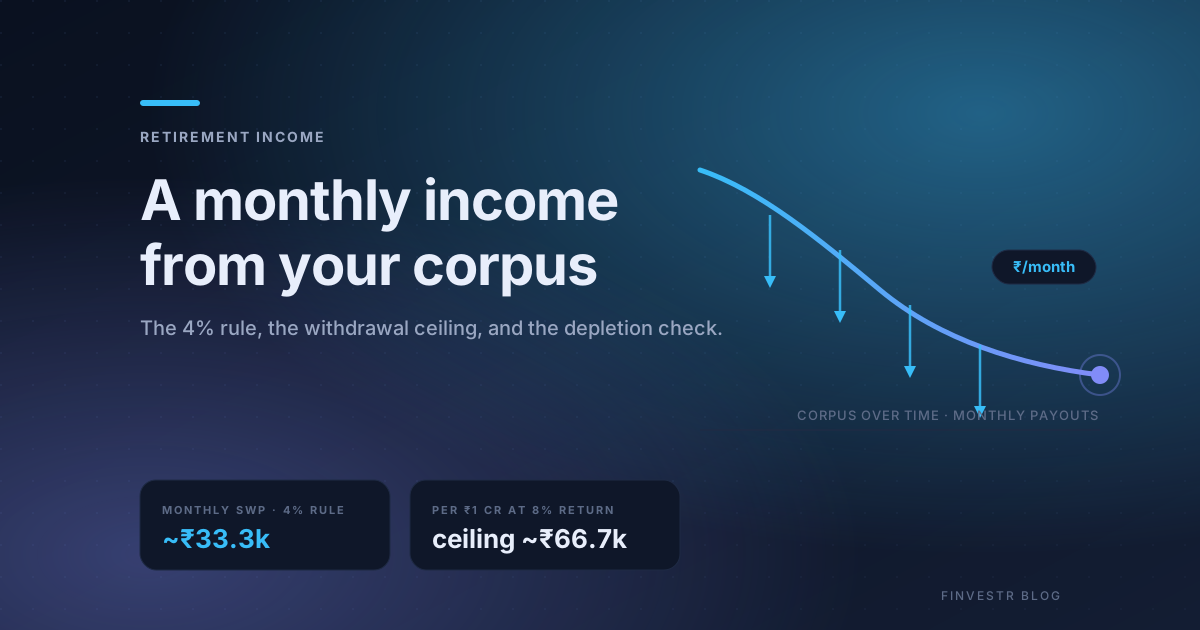
The 4% rule, the withdrawal ceiling, and the depletion check: how to size a monthly SWP from your mutual fund corpus so the income outlives you.
In this guide
- 1Start with the 4% rule: corpus multiplied by 4 percent, divided by 12, is your first month's withdrawal. For a 1 crore corpus that is about 27,777 rupees a month.
- 2Inflation-proof the number before you commit. A fixed withdrawal loses buying power every year, and the loss compounds just like returns do.
- 3Run the depletion check on the live calculator before you set anything up.
- 4Match the fund to the window and stay honest about the return assumption.
- 5Set it up with the AMC, then review the rate once a year.
Retirement planning asks two very different questions, and most advice stops at the first. Question one: how big does my corpus need to be? That is the accumulation problem, and we have covered it before. Question two: once the corpus exists, how much can I take out every month without the money running out before I do?
That second question is what a systematic withdrawal plan, or SWP, is built to answer. A standing instruction tells the fund house to redeem a fixed amount from your mutual fund every month and credit your bank account. The units left behind stay invested and keep compounding. It is a SIP in reverse: instead of feeding the corpus, you are harvesting it.
Sized well, an SWP turns a lump sum into salary-like income. Sized badly, it quietly eats the corpus and hands you a zero in year fourteen. This post walks through the sizing, with the real numbers from the same SWP calculator that lives in our free tools.
What an SWP actually is
Mechanically simple. You own, say, ₹1 crore of a balanced advantage fund. You instruct the AMC: pay me ₹50,000 on the 1st of every month. Each month the fund redeems enough units to produce ₹50,000 at that day's NAV and sends you the cash. Nothing else changes: the remaining units rise and fall with the market exactly as before.
Three things people confuse it with:
- Dividend option: the fund decides if and when to pay, and the payout floats. With an SWP you decide the amount and the date.
- STP: a systematic transfer plan moves money between two of your own funds during accumulation. An SWP pays you out during withdrawal. Different life stage, different job.
- Fixed deposit interest: FDs pay interest and preserve principal, but a decade of post-tax FD yields rarely beats inflation. An SWP from a hybrid fund earns equity-like returns on the portion left invested, which is the entire reason retirees tolerate the volatility.
Step 1: Start with the 4% rule
The classic starting point comes from US retirement research: withdraw 4% of the starting corpus in year one, raise it with inflation each year, and historically the money has lasted 30 years across almost every market sequence.
For a ₹1 crore corpus: ₹1,00,00,000 × 0.04 = ₹4,00,000 per year, or about ₹33,300 per month.
You will also see ₹27,777 quoted for this. That variant divides 4% as a monthly compounding allowance rather than a strict annual draw; it simply starts lower. We suggest starting near ₹33,300, then letting the depletion check below tell you whether to trim toward the conservative variant.
Indian planners often argue 4% is too conservative given equity-heavy portfolios have earned more here than in the US data. That may be true, but the safe direction for a retirement decision is down, not up. Start at 4%. Raise later only if the corpus behaves.
Step 2: Inflation-proof the withdrawal
Here is the part that ambushes retired investors around year ten. A fixed SWP amount feels stable in rupees and collapses in buying power. Using 6% inflation, a fair long-run assumption for a blended basket, our calculator math says:
₹40,000 ÷ 1.06^15 = ₹16,691
A fixed ₹40,000 withdrawal after fifteen years buys what ₹16,700 buys today. The corpus did not fail. The plan did.
You have two defensible choices, and hiding is not one of them:
1. Fix the amount for predictability and accept the erosion, knowing late-retirement expenses should fall anyway as some costs disappear.
2. Step up annually: start nearer ₹35,000 and increase ~5-6% yearly. Same lifetime spend profile, tighter early years.
What actually matters is deciding consciously rather than discovering year twelve from a bank statement.
Step 3: Run the depletion check
Now the mechanics. Every month the corpus compounds at the fund's return and then pays you:
new balance = (balance × (1 + annual return ÷ 12)) − monthly withdrawal
Repeat until either the term ends or the balance hits zero.
We ran this exact model on our live tool with realistic cases, and the results deserve a table:
| Corpus | Monthly SWP | Return | After 20 years |
|---|---|---|---|
| ₹1 crore | ₹40,000 | 8% | ₹2.57 crore, never depleted |
| ₹1 crore | ₹50,000 | 8% | ₹1.98 crore, never depleted |
| ₹1 crore | ₹60,000 | 8% | ₹1.39 crore, never depleted |
| ₹1 crore | ₹66,667 | 8% | breakeven: flat forever |
| ₹1 crore | ₹1,00,000 | 8% | depleted in month 166, i.e. year 14 |
The lesson hides in the last two rows. Around ₹66,700 a month there is a cliff edge where withdrawals exactly consume growth. Below it, compounding quietly wins: the ₹40,000 retiree ends with two-and-a-half times their starting money while drawing an income the whole time. Above it, the end date arrives sooner than anyone plans for, and a 12% withdrawal rate burns through a crore in fourteen years.
One caution before you circle ₹66,000: that number assumes 8% every single year, which no fund delivers. Sequences matter. Run the check again at a pessimistic 5-6%, especially for the early years. Same ₹60,000 withdrawal that grows the corpus at 8% instead drains it steadily at 6%, leaving under ₹31 lakh by year twenty-five. Withdrawal sizing must survive your bad decade, not your average one.
Step 4: Pick the right fund for the job
An SWP draws a constant stream out of a volatile pot, so the pot's volatility directly threatens your income floor. Matching:
- 5-10 year income windows, moderate drawdown tolerance: balanced advantage or aggressive hybrid. The allocation shifts with valuations and drawdowns stay contained relative to pure equity. Our balanced advantage rankings score the category monthly.
- Long horizons with flexible withdrawals: a flexi-cap or large-cap core can work, since the surplus years compensate for the bad ones, but pair it with two years of spending parked in debt so a crash never forces you to sell into weakness.
- Short windows: debt or arbitrage funds, full stop. Equity belongs nowhere near money needed within three years, including SWP money.
Step 5: Set it up, then review yearly
Setup takes one form with the AMC or your platform: scheme, folio, amount, date. First credit typically lands one cycle later. Anytime after the first year, which is when exit loads lapse, you can pause, resize, or stop.
Tax needs one paragraph here and no more for now. Each withdrawal is a redemption, so capital gains tax applies only to the gains embedded in that redemption, not the whole amount. Equity funds held over a year get the long-term treatment: the first ₹1.25 lakh of gains a year is exempt and anything beyond is taxed at 12.5%. Short-term equity gains are 20%, and debt-fund gains join your income at slab rates.
Then once a year, sit with the numbers: did the fund deliver near the return you assumed? Has the remaining corpus drifted from plan? Adjusting a ₹50,000 SWP down to ₹47,000 in a bad year is a minor course correction. Discovering the problem in year thirteen is not.
The takeaway
Sizing an SWP is not magic, it is arithmetic with honest inputs. Start near the 4% mark, roughly ₹33,000 a month per crore. Know the ceiling: around ₹66,000 per crore, withdrawals begin eating principal, and at ₹1 lakh per crore a crore dies in year fourteen. Respect inflation, because a fixed ₹40,000 shrinks to ₹16,700 of buying power in fifteen years. And match the fund to the window, with balanced advantage doing most income jobs well.
Open the SWP calculator, put in your own corpus and the number you think you need, then run it once more at 6% to see the pessimistic case. Two minutes there answers the question this post started with, and the goal planner connects it back to the corpus you are still building.
What to read next
If you are still building toward the corpus, how much do you actually need to retire in India works backward from your expenses to the target number. Once income design starts mattering, NPS vs ELSS for retirement covers the accumulator side of the tax question. For the fund itself, the balanced advantage shortlist scores the usual SWP candidates, and if any statement confusion arises mid-withdrawal, reading your CAS statement tells you exactly what those redemptions look like on paper.
Frequently asked questions
What is an SWP in mutual funds?▾
A systematic withdrawal plan is a standing instruction to redeem a fixed amount from a mutual fund every month. Units are redeemed automatically and the cash lands in your bank account. The units left behind stay invested and keep compounding. Think of it as a SIP in reverse.
How much can I withdraw monthly from 1 crore?▾
At a 4% initial rate, about 27,800 a month. At an 8% annualised return the breakeven withdrawal is roughly 66,000 a month: below that the corpus holds or grows, above it depletes. On the calculators we run, 40,000 a month at 8% leaves more than 2.5 crore intact after 20 years.
Is SWP better than the dividend option?▾
For most retirees, yes. Dividends are discretionary and can fall when markets fall, while an SWP pays a fixed amount you control. An SWP also tends to be tax cleaner because each payout is a redemption taxed as capital gains, not income distributed at the fund's discretion.
How is an SWP taxed?▾
Each withdrawal is a redemption, so capital gains tax applies only to the gains portion of the payout. In equity funds held over a year, the first ₹1.25 lakh of gains a year is exempt and the rest is 12.5%. Short-term equity gains are 20%.
Can I stop or change an SWP?▾
Yes. An SWP has no lock-in beyond any applicable exit load, usually nil after a year. You can pause it, change the amount, move the date, or stop it entirely with a request to the AMC or platform. Most investors review the amount annually against actual returns and inflation.
See your portfolio the way it should be seen.
Try the 1-min Goal Check