Best Balanced Advantage Funds in India (2026)
The only SEBI-recognised category with tactical asset allocation. Top picks by risk-adjusted return, drawdown control, and consistency over 3 and 5 year windows.
Every Indian investor hits the same wall around year 3. A goal that is too long for a liquid fund or fixed deposit, but too short to feel comfortable putting the entire corpus in equity. A house down payment in 4 years, a wedding fund in 3, a one-year career break in 5.
The mutual fund industry's answer to this wall is the balanced advantage fund (also called dynamic asset allocation fund). The category exists for exactly this band, and for exactly this reason: the equity allocation should change based on where the market is, not where you wish it were.
This post is the 2026 shortlist for the category. For each top pick, we name the rationale, the risk-adjusted return, and the drawdown control that makes it a credible choice. The live Balanced Advantage ranking has the full top 10 with month-on-month movement.
What a balanced advantage fund actually does
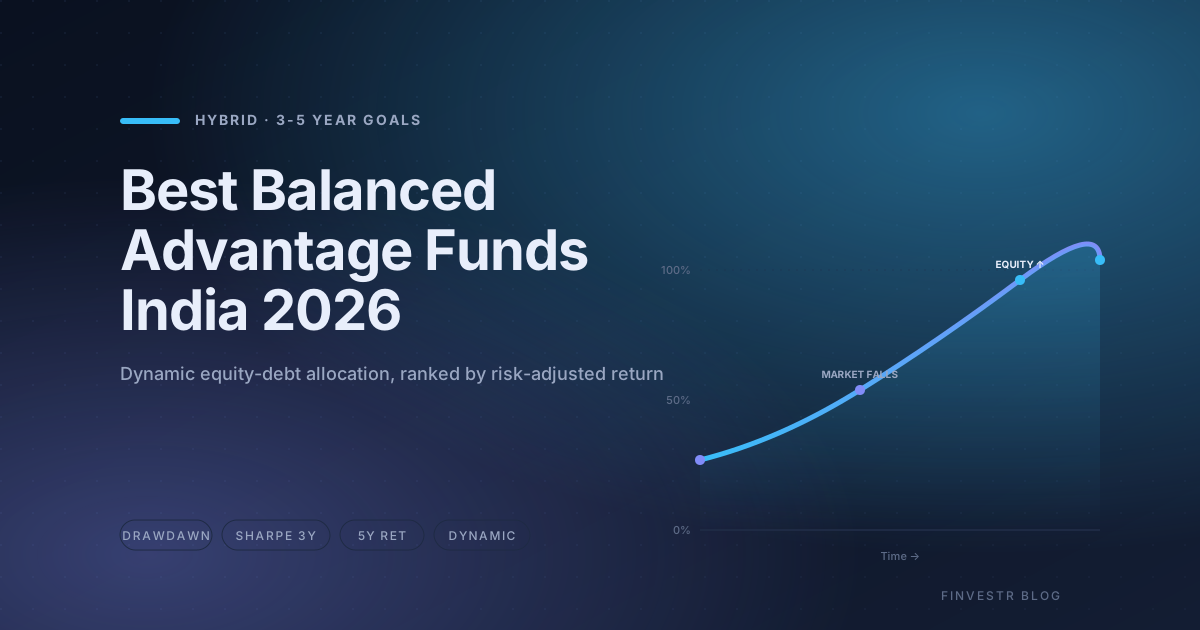
The structure is simple. The fund manager defines a valuation signal (usually the Nifty 50's trailing PE ratio relative to its long-term average) and sets the equity allocation based on that signal. When the PE is below the long-term average, equity allocation goes up to 70-80%. When it is above, allocation drops to 30-40%. The debt portion holds government securities, corporate bonds, or money market instruments.
The result is a fund with an equity-like long-run return and a debt-like drawdown profile. Over the last 10 years, the top balanced advantage funds have returned roughly 11-12% annualised, with a maximum drawdown of 8-12% in the worst year. A flexi-cap fund over the same period returned 14-15% but gave back 25-30% in 2020 and 15-20% in 2022.
The trade-off is that in sustained bull markets (2017, 2021, 2024), a balanced advantage fund will trail a pure equity fund because the equity cap at roughly 80% limits the upside. That is not a design flaw. The category is not designed to win in every market condition. It is designed to give you a smoother ride through the full cycle.
How to use this shortlist
The category matters more than the fund. All three top picks below are credible. The difference between them over a 4-year holding period is well within the noise of market returns. Pick the one with the lowest expense ratio (Direct plan) and the most transparent valuation methodology.
Check the equity allocation in your holding period. Some balanced advantage funds have been running at 60-70% equity since mid-2025, which is higher than the historical average. If you are in the 3-year band, a 70% equity allocation is aggressive for that horizon. The fund with the lowest equity allocation at the time of purchase is the safer pick for a 3-year goal.
Use the drawdown column, not the 1-year return. The 1-year return of a balanced advantage fund is largely a function of how much equity it held that year, not of manager skill. The 3-year max drawdown and the 5-year risk-adjusted return (Sharpe ratio) are the columns that separate a well-run fund from a poorly-run one.
Top picks for 2026
HDFC Balanced Advantage Fund
The largest fund in the category with an AUM above 40,000 crore. The HDFC fund uses a PE-based valuation band: equity allocation moves between 30% and 80% based on the Nifty 50's trailing PE relative to its 10-year average. The fund has been running at roughly 65-70% equity through most of 2026, which is on the higher end of its band.
Score highlights (as of July 2026):
- 5-year return: 12.1% (top quartile in category)
- 3-year return: 11.8% (top quartile)
- 3-year max drawdown: 8.2% (lowest in top 5)
- Sharpe 3Y: 1.4 (top quartile)
- Expense ratio (Direct): 0.58%
The HDFC fund wins on drawdown control. In the 2022-23 correction, when the Nifty fell 12% from peak to trough, this fund's NAV dropped 8%. The debt sleeve (primarily government securities and AAA corporate bonds) absorbed roughly half the equity hit. For a 3-5 year goal where capital preservation matters, this is the cleanest pick in the category.
ICICI Prudential Balanced Advantage Fund
The second-largest fund in the category, with an AUM above 25,000 crore. The ICICI Prudential fund uses a multi-factor signal that combines the Nifty PE with a bond-yield model and a macro overlay. The equity allocation has historically ranged between 35% and 75%, and has been running at roughly 60-65% in 2026.
Score highlights:
- 5-year return: 11.9% (top quartile)
- 3-year return: 12.2% (top quartile)
- 3-year max drawdown: 9.1%
- Sharpe 3Y: 1.3
- Expense ratio (Direct): 0.55%
The ICICI fund has the highest 3-year return in the top 5, driven by a value-tilt in the equity sleeve (overweight to financials and PSUs in the 2024-2026 cycle). The drawdown is slightly higher than the HDFC fund but the 3-year return more than compensates. For an investor with a 5-year horizon who wants the highest return within the category, this is the pick.
Kotak Balanced Advantage Fund
The third-ranked fund in the category by AUM and by score. The Kotak fund uses a quantitative model with multiple factors: PE ratio, market cap to GDP, and a volatility-adjusted momentum signal. The equity allocation has ranged between 30% and 70%, and has been running at roughly 55-60% in 2026.
Score highlights:
- 5-year return: 11.5% (top quartile)
- 3-year return: 11.0% (second quartile)
- 3-year max drawdown: 7.8% (lowest in the top 3)
- Sharpe 3Y: 1.2
- Expense ratio (Direct): 0.60%
The Kotak fund has the lowest drawdown among the top 3, at 7.8%, because its quantitative model reduced equity allocation earlier than the PE-based models in the 2022 correction. The trade-off is a slightly lower 3-year return. For an investor in the 3-year band where every percentage point of drawdown matters, the Kotak fund is the safest pick.
How these funds differ from each other
The three funds share a common structure (dynamic equity-debt allocation based on a signal) but differ on three axes.
The valuation signal. HDFC uses a pure PE-based band, which is transparent and easy to back-test but slow to react in fast-moving markets. ICICI uses a multi-factor signal that adds a macro overlay, which is faster but less transparent. Kotak uses a quant model with multiple factors, which is the most responsive but also the hardest to understand without a data science background.
The equity sleeve composition. HDFC's equity book is a large-cap-heavy portfolio (60-70% Nifty 50 names) with a modest mid-cap allocation. ICICI's book has a value tilt, overweight to financials and PSUs. Kotak's book is closer to the Nifty 50 in composition, with a modest quality-growth tilt.
The debt sleeve quality. All three primarily hold government securities and AAA corporate bonds. HDFC has the highest allocation to government securities (roughly 70% of the debt sleeve), which makes its debt portfolio the most credit-resilient. ICICI holds roughly 50% government securities and 50% AAA corporate bonds. Kotak is closer to ICICI in the mix.
For a retail investor, these differences matter less than the fund's consistency over 3 and 5 year windows. A balanced advantage fund held for 4 years during which the Nifty PE moves from 22 to 18 generates most of its return from the rebalancing, not from the stock-picking.
How to build a portfolio with a balanced advantage fund
Three worked scenarios, by goal.
The 35-year-old's house down payment (4-year horizon):
- 100% HDFC Balanced Advantage Fund (Direct): one fund, no rebalancing needed
- Step up the monthly investment by 10% annually
- The dynamic allocation handles the market-timing question
The 28-year-old's wedding fund (3-year horizon):
- 70% Kotak Balanced Advantage Fund (lowest drawdown in the category)
- 30% ICICI Prudential Short Term Fund (debt buffer, 1-3 year horizon)
- Rebalance once a year: keep the blended drawdown under 6%
The 50-year-old's pre-retirement bucket (5-year horizon):
- 60% ICICI Prudential Balanced Advantage Fund (highest 3-year return in the category)
- 40% HDFC Short Term Debt Fund (debt buffer, capital preservation)
- The equity exposure at roughly 35-40% of the combined portfolio keeps the drawdown under 8% while generating 9-10% long-run return
These are starting points, not prescriptions. The FinvestR-Agent sizes the allocation to your exact goal amount, horizon, and tax slab, and rebalances the portfolio automatically each month.
The takeaway
A balanced advantage fund is the right answer for any 3-5 year goal where you cannot afford to lose 20% of your corpus but you also cannot afford to earn 7% in a fixed deposit after tax. The dynamic allocation handles the market-timing question, the expense ratio is low enough that the compounding works, and the drawdown control is real enough that you will stay invested through a correction. The three funds above HDFC, ICICI Prudential, and Kotak are the credible 2026 shortlist. The live Balanced Advantage ranking has the full top 10 with month-on-month movement, refreshed every month.
If you already have a specific goal in mind the down payment, the wedding, the career break the FinvestR-Agent will build a portfolio sized to your exact numbers, rebalance the allocation as the market moves, and flag concentration risk before it becomes a problem. The whole point of the platform is to make the shortlist actionable, and to keep it that way as the goal gets closer.
What to read next
- The full Balanced Advantage ranking for the current top 10 funds in the category.
- Mutual Fund vs FD in India 2026 if you are still parking your 3-5 year goal in a bank deposit and wondering whether the extra 3-4% return is worth it.
- How to start investing in mutual funds in India for the account-opening and SIP setup flow.
- Best mutual funds to invest in India 2026, the pillar post that covers every category a long-horizon investor needs.
Frequently asked questions
What is a balanced advantage fund?▾
A balanced advantage fund (formerly called dynamic asset allocation fund) holds a variable mix of equity and debt. The fund manager shifts the equity allocation up or down based on a valuation signal, usually the Nifty 50 PE ratio. When markets are cheap, equity allocation goes up to 70-80%. When markets are expensive, allocation drops to 30-40%. The debt portion takes the other side. The goal is dampened drawdowns without capping the long-run return.
Is a balanced advantage fund better than an aggressive hybrid fund?▾
For a 3-5 year goal, yes, because the dynamic allocation is the entire product. An aggressive hybrid fund holds a fixed 65-80% equity regardless of valuations, which means it participates fully in the downside. A balanced advantage fund reduces equity exposure when valuations are high, which is also when drawdown risk is highest. Over a full cycle, the balanced advantage category typically delivers similar returns to aggressive hybrid with 30-40% lower maximum drawdown.
How is a balanced advantage fund taxed?▾
Balanced advantage funds are treated as equity-oriented hybrid funds for tax purposes as long as they maintain at least 65% equity exposure on average. Gains held for more than 12 months are treated as long-term capital gains (LTCG), with the first 1.25 lakh per year exempt and any excess taxed at 12.5%. Gains held for less than 12 months are short-term capital gains (STCG), taxed at 15%. If the fund's equity exposure drops below 65% on average, it is taxed as a debt fund, meaning the gains are added to your income and taxed at your slab rate.
Which is the best balanced advantage fund in India in 2026?▾
The HDFC Balanced Advantage Fund, ICICI Prudential Balanced Advantage Fund, and Kotak Balanced Advantage Fund are the top 3 picks in 2026 based on 5-year risk-adjusted returns, drawdown control, and consistency. The HDFC fund is the largest in the category with a 5-year return in the top quartile and a drawdown meaningfully below the category median. The ICICI Prudential fund has a strong 3-year and 5-year record with a value-tilt bias. The Kotak fund is a consistent performer with a 5-year return meaningfully above the category median. See the full rankings link below for the complete top 10.
What is the right horizon for a balanced advantage fund?▾
Three to five years is the sweet spot. Below 3 years, the equity portion introduces meaningful drawdown risk that a liquid fund or short-duration debt fund would avoid. Above 7 years, a pure equity fund (flexi cap or large cap) will almost certainly beat a balanced advantage fund because the equity allocation cap at roughly 80% limits the upside in sustained bull markets. The category exists for goals that are too long for debt but too short to stomach full equity volatility.
Can I invest a lump sum in a balanced advantage fund at market peak?▾
Yes, and that is the single best use case for this category. If you have a large lump sum and the market is at an all-time high (as the Nifty 50 often is), a balanced advantage fund will automatically allocate less to equity and more to debt because the valuation signal will be high. As the market corrects and valuations become cheaper, it will gradually increase equity exposure. This is the opposite of what most investors do emotionally (buying at peaks, selling at bottoms). The fund does the rebalancing for you.
Which balanced advantage fund has the lowest drawdown?▾
Among the top 3 picks, the HDFC Balanced Advantage Fund has the lowest 3-year maximum drawdown, roughly 8-10% in the 2022-23 correction, compared to the category median of 12-14%. The ICICI Prudential fund is close behind at roughly 9-11%. The drawdown advantage is the whole reason to buy this category: the dynamic allocation is supposed to reduce equity exposure before drawdowns arrive.
See your portfolio the way it should be seen.
Try the 1-min Goal CheckRelated reading
Best mutual funds and index funds to invest in India (2026)
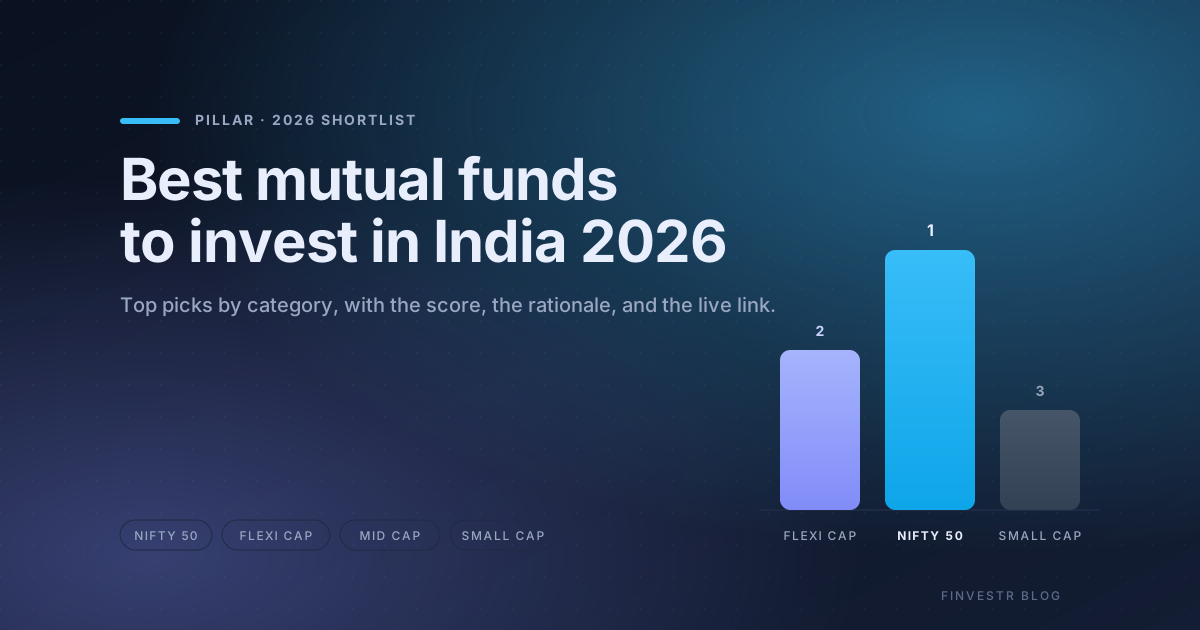
The 2026 shortlist across every category that matters for an Indian investor: large cap, flexi cap, mid cap, small cap, ELSS, index, debt, liquid. With the score, the rationale, and the live rankings link for each.
Best mutual funds for 5-10 years: how to pick by horizon
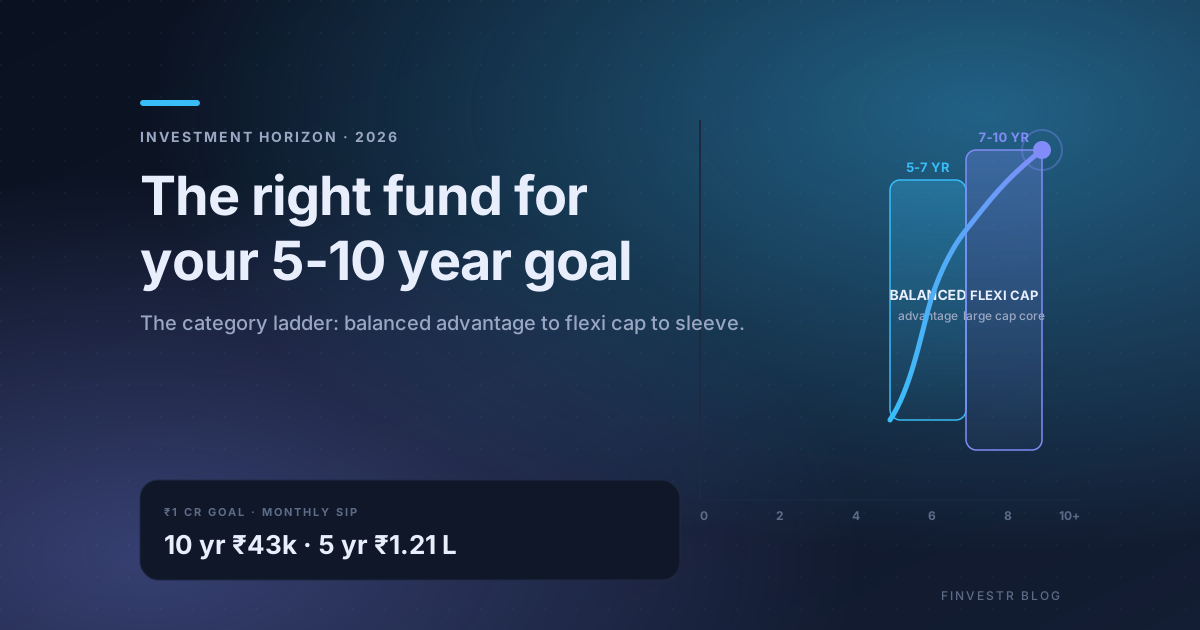
House down payment, wedding, career break: the 5-10 year band is where most Indian goals live. Which fund categories belong there, with the real SIP math.
Quant's sweep: when one AMC tops five categories
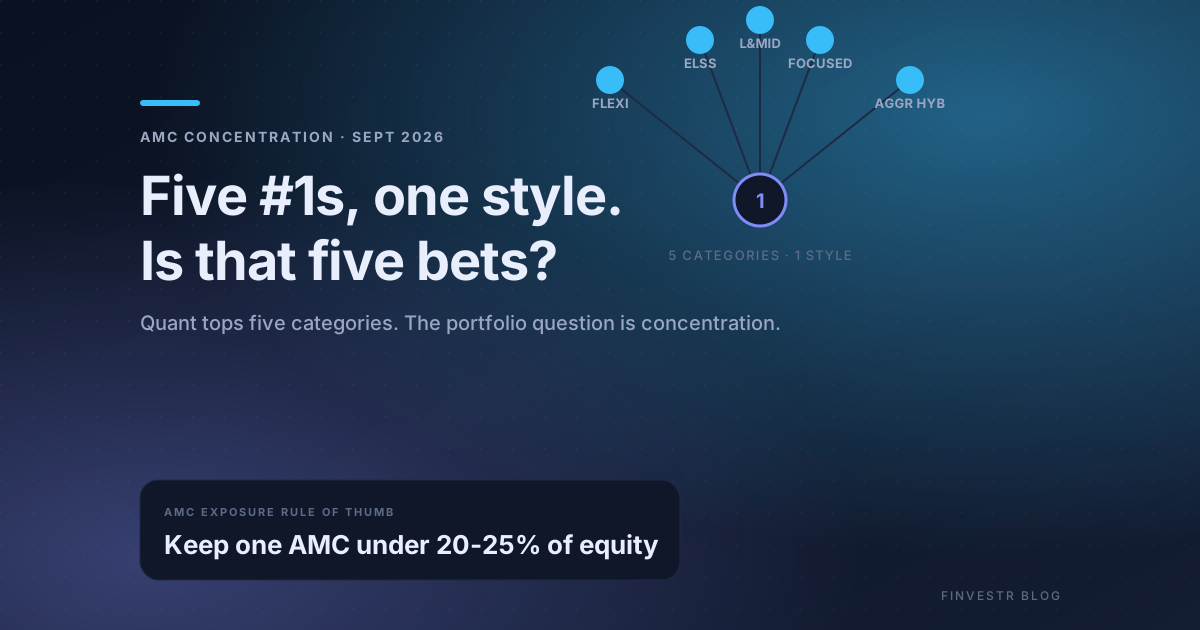
Five Quant funds at #1 in the September rankings is not five independent wins. It is one investment style working across a book. Here is the AMC-concentration question it raises.