How to Find Duplicate Mutual Funds in Your Portfolio
The four ways duplicate funds sneak into an Indian portfolio, how to spot them by AMC, category, top holdings, and fund manager, and how to consolidate to a leaner, cheaper set.
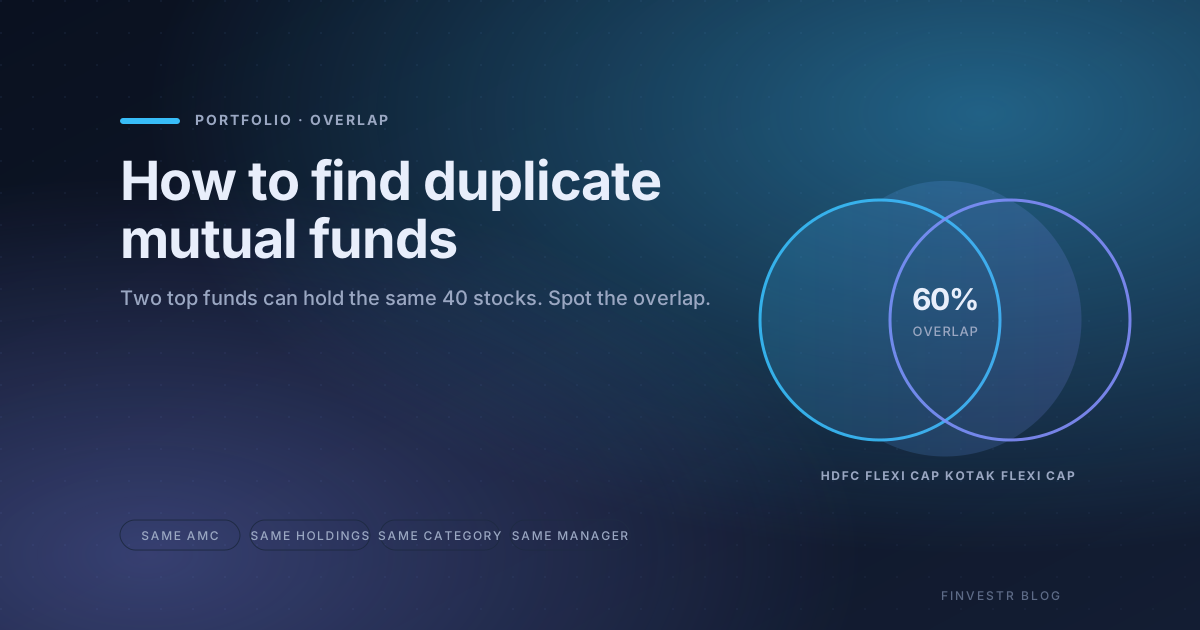
Two top-ranked mutual funds can hold the same 40 stocks. HDFC Flexi Cap and Kotak Flexi Cap may both hold Reliance, HDFC Bank, ICICI Bank, Infosys, and a dozen more of the same large caps, in similar weights. Buy both because each is a "top fund" and you have not built two bets. You have built one bet on Indian large caps, with two expense ratios.
This is how duplicate funds sneak into an Indian portfolio. Not through a single bad decision, but through a series of reasonable ones: following a recommendation, buying a second "top" fund, adding a fund without checking what you already hold. The result is a portfolio that looks diversified on paper and is quietly concentrated underneath.
This post is the practical guide to finding those duplicates, by AMC, by category, by top holdings, and by fund manager, and to consolidating to a leaner, cheaper set.
Why Indian investors end up with duplicate funds
The path to a duplicate portfolio is almost always the same. You read that HDFC Flexi Cap is a top-ranked fund, so you start a SIP. A year later you read that Parag Parikh Flexi Cap is also top-ranked, so you start a second SIP. Both are flexi-cap funds. Both hold the same large-cap core. You now have two funds doing the same job.
The pattern repeats across categories. A Nifty 50 index fund, a large-cap fund, and a flexi-cap fund from the same house can share 60-80% of their holdings. The categories sound different. The underlying portfolios are not.
Three habits drive it:
- Following recommendations without checking overlap. Every "top fund" list is built one fund at a time. Nobody tells you that the top flexi-cap and the top large-cap from the same AMC hold the same 30 stocks.
- Buying multiple "top" funds in the same category. Two flexi-cap funds from different AMCs still hold the same large-cap core. The manager's stock-picking is the 10-20% around the edges, not the core.
- Never consolidating. The portfolio grows by addition and never by subtraction. Each new fund is a reasonable decision in isolation. Together they are a pile of overlapping bets.
The cost is not just the extra expense ratios. It is the false sense of diversification. An investor holding 6 overlapping equity funds believes they are diversified. They are not. They are holding one bet on Indian large caps, multiplied by 6 fees.
How to spot a duplicate: the four checks
You do not need a Bloomberg terminal. You need your CAS (Consolidated Account Statement, the monthly statement every Indian investor can download from CDSL or NSDL via MFCentral, CAMSOnline, or your AMC) and the latest factsheet of each fund.
Check 1: same AMC. Two funds from the same asset management company, run by the same fund manager, often behave like one fund. Three funds from HDFC, regardless of category, usually share 50-60% of their underlying stocks. The practical rule: no more than 2 funds per AMC in the core portfolio. If you hold HDFC Large Cap, HDFC Flexi Cap, and HDFC Mid Cap, that is one fund manager's view of the market across three categories, not three independent bets.
Check 2: same category. A flexi-cap and a multi-cap from the same house usually overlap 50-70%. A flexi-cap and a large-cap from the same house overlap 60-80%. Two funds in the same SEBI category are structurally similar by design. Holding two of them is holding the same bet twice unless the managers are genuinely different.
Check 3: same top holdings. This is the ground truth. Open the factsheet of each fund and compare the top 10 holdings. If two funds both list Reliance, HDFC Bank, ICICI Bank, Infosys, and Bharti Airtel in their top 10, the overlap is real regardless of what the category labels say. The FinvestR-Agent computes this stock-level overlap for every pair in your portfolio automatically, using the latest factsheet holdings.
Check 4: same fund manager. A single fund manager running two of your funds is a single point of view. If the same person manages your large-cap and your flexi-cap fund, the two funds are likely to drift together. That is not diversification. It is one brain making two decisions.
What overlap looks like in practice
The cleanest example is two flexi-cap funds from different AMCs. HDFC Flexi Cap and Kotak Flexi Cap are both top-ranked funds. Both are allowed to invest anywhere in the market-cap spectrum. In practice, both anchor on the same large-cap core, because the top Indian large caps dominate every equity fund's benchmark.
A realistic overlap: the two funds hold 35 of the same 40 stocks. The weights differ a little, and each has a few mid-cap or small-cap names the other does not. But the behaviour of the two funds is driven by the same 35 stocks. If Reliance falls 5%, both funds fall. If HDFC Bank reports weak results, both funds react. You are not hedged. You are doubled.
The same logic applies to a Nifty 50 index fund and a large-cap fund from the same house. The overlap is 80-90% by design. That is fine if you are deliberately using the index as a benchmark and the active fund as a high-conviction overlay. It is not fine if you thought you were getting two different bets.
How AMC concentration works
AMC concentration is the share of your mutual fund corpus held with a single asset management company. It is the portfolio-level version of the same-AMC check, and it is the one most investors never look at.
The FinvestR-Agent computes this on every CAS upload. It sums the value of all your mutual fund holdings by AMC and reports the percentage each AMC represents. The insight is blunt: if 50% or more of your mutual funds are with one AMC, you are exposed to one fund manager's view of the market, even if the funds are in different categories.
A worked example. You hold HDFC Flexi Cap (₹4L), HDFC Large Cap (₹3L), HDFC Mid Cap (₹2L), and Parag Parikh Flexi Cap (₹3L). Total mutual fund corpus: ₹12L. HDFC holds ₹9L, which is 75% of the corpus. On paper you have 4 funds and 3 categories. In practice, 75% of your money is one fund house's view of the market, and the 3 HDFC funds share roughly 60% of their holdings.
The practical rule: no single AMC above roughly 30-40% of the corpus, and no more than 2 funds per AMC. The fix is to keep the best fund per AMC and redeem the rest.
How to consolidate: keep the right fund
When two funds overlap, you do not have to keep both. The decision comes down to three tie-breakers, in order:
- Lower expense ratio. All else equal, the cheaper fund wins. A 0.3% difference in TER (Total Expense Ratio, the annual fee the fund charges) compounds to a meaningful gap over 10-20 years. On a ₹5L position, 0.3% is ₹1,500 a year, every year.
- Better 5-year track record. Compare the two funds on 5-year returns and on how they behaved in a down year. The fund that fell less in the 2022 drawdown and recovered faster is the better risk-adjusted hold.
- Better category fit. If your portfolio already has a large-cap core, keep the flexi-cap that adds mid-cap exposure, not the one that duplicates the core. The fund that adds the most marginal diversification is the one to keep.
Before you redeem, check the tax impact. Equity mutual fund gains above the ₹1.25L long-term capital gains exemption are taxed at 12.5%. If the fund you are redeeming has a large unrealised gain, the tax bill is part of the decision. Sometimes it is worth paying to simplify. Sometimes it is better to stop new SIPs into the redundant fund and let it ride.
The FinvestR-Agent does this automatically
Every check in this post is something the FinvestR-Agent runs on every CAS upload. It does not ask you to open factsheets or compare top-10 lists by hand.
- Concentration. It computes what percentage of your portfolio sits in your top 3 holdings, and flags anything above 50% as worth watching.
- AMC exposure. It sums your mutual fund corpus by AMC and flags any single AMC above 50% of the total.
- Category mix. It breaks your portfolio down by SEBI category and shows you the equity vs debt split, so you can see at a glance whether you are holding three flexi-cap funds.
Upload your CAS and the agent does the four checks, ranks the overlapping pairs by severity, and tells you which fund to keep and which to redeem, with the tax impact of the exit calculated.
The takeaway
Duplicate funds are the silent tax on Indian retail portfolios. Two top-ranked funds can hold the same 40 stocks, and buying both gives you one bet with two expense ratios. The four checks are simple: same AMC, same category, same top holdings, same fund manager. The fix is to keep the fund with the lower expense ratio, the better 5-year record, or the better category fit, and redeem the rest.
The right portfolio has 4-6 funds in 2-3 categories, no more than 2 funds per AMC, and every fund doing work you can articulate. If you cannot explain why a fund is in the portfolio, it is a candidate to exit.
Upload your CAS to the FinvestR-Agent and it will find the duplicates for you, rank the overlap, and show the tax impact of every recommended exit. The whole point is to make the lean portfolio the path of least resistance.
What to read next
- Is your mutual fund portfolio over-diversified? - the four checks for the 8-fund trap, the closest sibling to this post.
- Best mutual funds to invest in India 2026 - the pillar shortlist, with the top pick per category, so you know which fund to keep when two overlap.
- XIRR vs CAGR vs Absolute Returns - how to read the return number on your CAS, the only way to know if the consolidation actually helped.
- The monthly mutual fund rankings - the live top-10 in every category, for when the consolidation calls for a new top-quartile pick.
Frequently asked questions
What does it mean when two mutual funds overlap?▾
Overlap means two funds hold many of the same stocks. Two flexi-cap funds from different AMCs can hold 30-40 of the same 40 stocks, because the top Indian large caps (Reliance, HDFC Bank, ICICI Bank, Infosys) dominate every equity fund. The overlap is not a problem by itself. It becomes a problem when you hold both funds and think you have two independent bets, when you actually have one bet with two expense ratios.
How many mutual funds is too many?▾
For a typical Indian retail investor, 4-6 funds across 2-3 categories is the sweet spot. Above 8 funds, the portfolio is almost always over-diversified, with several funds duplicating the same exposure. The test: if removing a fund would not change the portfolio's behaviour, that fund is a duplicate. The FinvestR-Agent runs this count and the overlap check on every CAS upload.
What does AMC concentration mean?▾
AMC concentration is the share of your mutual fund corpus held with a single asset management company. If 50% or more of your funds are with one AMC, you are exposed to one fund manager's view of the market, even if the funds are in different categories. The practical rule is no more than 2 funds per AMC in the core portfolio, and no single AMC above roughly 30-40% of the corpus.
How do I check overlap between two funds myself?▾
The cleanest way is stock-level overlap: compare the top 10 holdings of each fund from their latest factsheets and count how many stocks appear in both. A simpler proxy is the AMC and the category. Two funds from the same AMC in the same category almost always share 50-70% of their holdings. Two Nifty 50 index funds overlap 95%+. The FinvestR-Agent computes the exact stock-level overlap for every pair in your portfolio automatically.
Which fund should I keep when two overlap?▾
Keep the fund with the lower expense ratio, the better 5-year track record, or the better fit for your category allocation. If the two funds are otherwise equal, keep the one from the AMC you are less concentrated in. Before redeeming, check the tax impact: equity fund gains above the ₹1.25L LTCG exemption are taxed at 12.5%.
See your portfolio the way it should be seen.
Try the 1-min Goal CheckRelated reading
How to Read Your CAS Statement in India (2026 Guide)
A plain-English walkthrough of the Consolidated Account Statement: what each section means, how to read the valuation and XIRR numbers, the CAMS vs Kfintech difference, and how to spot overlapping funds and concentrated AMC exposure.
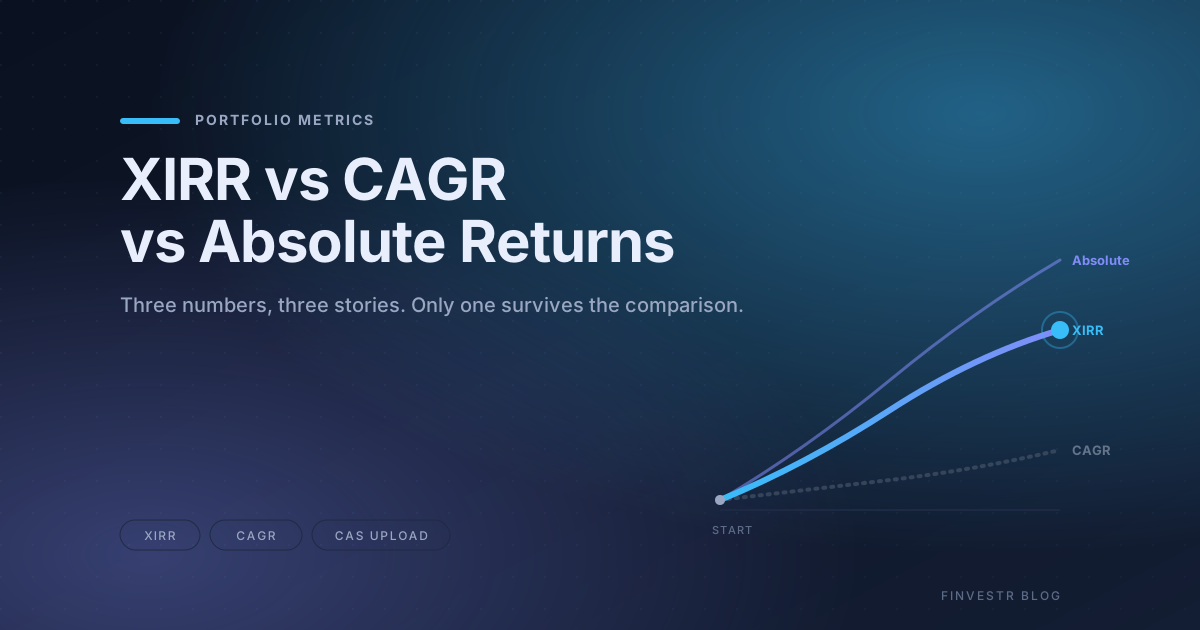
XIRR vs CAGR vs Absolute Returns: what your statement hides
Why the 14% on your CAS statement is not the return you actually earned, what XIRR and CAGR really measure, and which one to use when you compare your portfolio to the Nifty.

Is your mutual fund portfolio over-diversified?
The four practical checks for over-diversification: count the funds, look at AMC overlap, measure category overlap, and check if your top 3 funds are doing all the work. With a worked example and a fix.