Mutual fund capital gains tax in India 2026
A plain-English walkthrough of how equity and debt mutual fund gains are taxed in 2026, with the ₹1.25 lakh exemption, the slab-rate rule for debt funds, and the harvest-the-exemption strategy that keeps more of your returns.
Every redemption is a taxable event, and the rate depends on two things only: what kind of fund you hold, and how long you held it. Get those two right and the whole calculation falls into place. Get them wrong and you can hand a third of your gains to the taxman without meaning to.
Equity funds: the 12.5% LTCG and the ₹1.25L exemption
An equity-oriented fund is one that keeps at least 65% of its assets in domestic equities. For these, the holding period that separates short-term from long-term is 12 months.
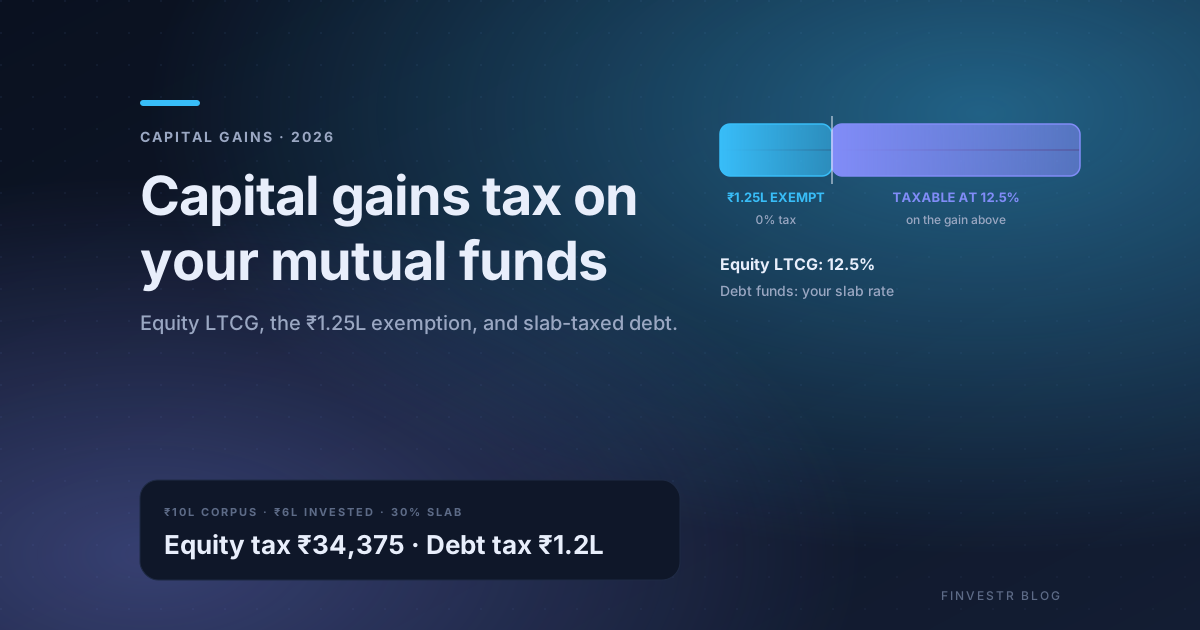
- Long-term (held more than 12 months): gains are taxed at 12.5%, but only on the amount above ₹1.25 lakh in a financial year. The first ₹1.25 lakh of your total long-term equity gains is tax-free.
- Short-term (held 12 months or less): taxed at a flat 20%, with no exemption. The entire gain is taxable from the first rupee.
The ₹1.25 lakh exemption is an aggregate limit. It is not per fund and not per transaction. It covers all your listed equity shares and equity-oriented mutual funds combined in one financial year. So if you redeem three funds in the same year and your total LTCG is ₹1.5 lakh, only ₹25,000 is taxable, at 12.5%.
There is no indexation on equity funds. Your taxable gain is simply the sale value minus your purchase cost, with no inflation adjustment.
Debt funds: slab rate, always
Debt funds are where the rules changed hardest. For units bought on or after 1 April 2023, every gain is treated as short-term, no matter how long you hold the fund. The gain is added to your income and taxed at your slab rate, with no long-term rate and no indexation.
This is why a debt fund held for five years is taxed exactly like one held for five months. The old "hold for three years, pay 20% with indexation" deal is gone for new purchases. Units bought before 1 April 2023 still get the older treatment: 12.5% LTCG after 24 months, though without indexation.
For a 30% slab investor, that means debt fund gains are taxed at 30% from the first rupee, while equity gains get the ₹1.25 lakh free pass and then just 12.5%. The gap is enormous, and it is the single biggest reason to think about post-tax returns, not headline returns.
The worked example: same corpus, two tax treatments
Let's put real numbers on it. Say you built a ₹10 lakh corpus from ₹6 lakh invested, a gain of ₹4 lakh, and you are in the 30% slab. Here is what the FinvestR post-tax comparison calculator actually computes:
- Equity fund: taxable gain of ₹2.75 lakh (₹4 lakh minus the ₹1.25 lakh exemption), tax of ₹34,375, leaving a post-tax corpus of ₹9,65,625.
- Debt fund: the full ₹4 lakh gain is taxable at 30%, tax of ₹1,20,000, leaving a post-tax corpus of ₹8,80,000.
Same ₹10 lakh corpus, and the equity route keeps ₹85,625 more. That is the tax difference in one number.
Now take a smaller case, a gain of exactly ₹1.25 lakh. The equity fund pays zero tax, because the entire gain sits inside the exemption. The debt fund still pays ₹37,500 at 30%. This is why the exemption is not a rounding error: for modest redemptions from a long-running SIP, your actual LTCG in a year is often below the threshold, and you owe nothing.
Harvest the exemption: the strategy that pays
The ₹1.25 lakh exemption resets every financial year. If you do not use it, you lose it. That is the entire logic of tax harvesting.
The move is simple. Near the end of the financial year, if your unrealised long-term equity gains are approaching ₹1.25 lakh, you sell enough units to book the gain, then immediately buy them back. The gain is tax-free, and your cost basis resets higher, so the next year's gain starts from a higher floor. There is no wash-sale rule in India, so you can repurchase the same fund the next day.
Two caveats. First, the exemption is shared with your direct equity holdings, so count your stock gains too before you harvest. Second, do not let the tax tail wag the investment dog: only harvest if you want to keep the exposure. If you are redeeming to spend the money, the exemption is simply a free discount on your withdrawal.
Capital losses are the mirror image. A short-term loss can be set off against both short-term and long-term gains. A long-term loss can only be set off against long-term gains. Unused losses carry forward for up to eight assessment years, provided you file your return on time. So if you have a fund sitting at a loss, selling it to book the loss can pull your taxable gain back under the exemption. In the worked example above, a ₹80,000 long-term loss would have cut the ₹2.75 lakh taxable gain to ₹1.95 lakh, saving you ₹10,000 in tax. Book the loss, reinvest, and let the market do the rest.
The takeaway
Equity funds are the tax-efficient long-term choice: 12.5% on gains above a ₹1.25 lakh annual exemption, and nothing at all if your gains stay under it. Debt funds bought since April 2023 are taxed at your slab rate, always, with no long-term benefit.
The rates that apply to FY 2026-27 were set by Budget 2024 and confirmed unchanged by Budget 2026. The one thing to watch is the new Income-tax Act, 2025, which renumbered the old sections (111A and 112A became 196 and 198) from 1 April 2026. The rates and thresholds did not change, only the citations.
Use the exemption every year or lose it. Book gains up to ₹1.25 lakh, book losses to offset the rest, and keep your cost basis resetting higher. The difference between a tax-aware and a tax-blind investor is not small: in the worked example it was ₹85,625 on a single ₹10 lakh corpus.
Run your own numbers before you redeem. The post-tax comparison calculators on the FinvestR tools page will show you the equity-versus-debt gap for your actual corpus, slab, and holding period, so you are not guessing at the tax bill.
What to read next
If you are choosing between the two most common tax-saving routes, see ELSS vs PPF: which 80C option is better for you. For the math behind how a SIP actually compounds into the corpus you will one day redeem, read the SIP calculator math. To see which funds are worth holding long enough to earn that 12.5% rate, check the monthly rankings. And if you want a quick, personalised read on your own tax situation, the 1-minute goal check is a good place to start.
Frequently asked questions
What is the LTCG tax rate on equity mutual funds in 2026?▾
12.5% on long-term gains above the ₹1.25 lakh annual exemption. Hold units for more than 12 months and the gain is long-term. Only the amount over ₹1.25 lakh in a financial year is taxed, and there is no indexation.
Is the ₹1.25 lakh exemption per fund or in total?▾
In total. It is an aggregate annual limit across all your equity shares and equity-oriented mutual funds combined, not per fund. If your total LTCG for the year is ₹1.5 lakh, only ₹25,000 is taxable at 12.5%.
How are debt mutual funds taxed in 2026?▾
Units bought on or after 1 April 2023 are always taxed at your income tax slab rate, no matter how long you hold them. There is no long-term rate and no indexation. Units bought before that date can still get 12.5% LTCG after 24 months.
What is the STCG rate on equity mutual funds?▾
20% flat, with no exemption threshold. If you sell equity fund units within 12 months of buying them, the entire gain is taxed at 20% from the first rupee. This rate has applied to transfers on or after 23 July 2024.
What is tax-loss harvesting and does it work in India?▾
Selling a losing fund to book a capital loss that offsets your gains, then reinvesting. Short-term losses offset both short and long-term gains; long-term losses offset only long-term gains. There is no wash-sale rule in India, so you can buy back the next day.
See your portfolio the way it should be seen.
Try the 1-min Goal Check